
Loving the new look for Mastodon 5.0.
Internet
The web, online culture, and how we use the internet.
Yip, you’ve heard it before, but it’s still worth putting this out there.
You don’t own shit that you put on social media platforms. You don’t own your follower counts, you don’t own your posts. Stop giving away all of your shit to data harvesters and advertisers for free in exchange for the illusion of importance that comes with likes and a follower count. Set up a website — and while you’re at it, start a mailing list, because email is basically the only means of reaching your contacts that can’t easily be taken away from you.
I’ve been using DuckDuckGo for years, but other than their privacy stance, there’s not much else to keep me there.
I’ve been intrigued by the interest in Kagi in my Micro.blog timeline over the last few months. So much so that I created a free account for myself today. Loving it so far!
Finally, I did it—deleted my Twitter account. It started out as such a fun and exciting place on the web, and it hasn’t been like that for me for a few years now. I’m glad I pulled the plug on it.
I’ve seen many posts about people cancelling their Washington Post subscriptions, but I wonder if cancelling your Amazon Prime is the way to go?
The best thing those readers can do is cancel their $139 annual Prime subscriptions, if they have them, and invest that money in the journalism they say they want and need.
I like The Atlantic’s point about hitting Bezos where it matters: Amazon Prime subscriptions. Newspaper subscriptions allow for more independent journalism; we shouldn’t deprive ourselves of that.
Still scrolling through Reddit’s /r/coolguides group thanks to @Annie’s earlier post. So many good guides!
I’m still following 25 people on the bird site. I check in here once every few weeks to see what’s what. On a slightly related note, I still can’t understand why more organisations are not running their own Mastodon instances. Too complicated? Unproven technology?
I miss Twitter’s lists feature when I’m on Micro.blog, Instagram, and Threads. On Twitter, I had lists for a handful of topics that I looked at daily, such as the NFL, notebooks, people, and web development. It was nice to scroll through related content and change to something else.
Crawling back to X?
David Heinemeier Hansson recently posted about X’s appeal.
Everything that happens, everyone who matters, is on X first. Even the most rabid Musk haters come crawling back to this platform when it counts.
— DHH, X
I’m afraid I have to disagree with this.
X was the place I checked first when something happened. It’s definitely the last place I check now. A news website like The Guardian might be where I start if there’s some breaking news story. If it’s tech-related, I’ll go to Hacker News and then possibly The Verge for more information on the story.
As for the “everyone who matters” part, I see X now as nothing more than a platform for technical people. Yip, many friendly people are on there, and they are still posting interesting stuff. Still, the general vibe to me is that it’s an excellent place for those in tech but not much else. For me, it’s become an echo chamber.
So, are others still crawling back to X?
Not for me. I might check my X timeline once a day and bookmark a few things to read later, but that’s the extent of my interaction on X. It’s not the source of good content that it was a few years back. It’s definitely not the platform that counts for everyone.
Everywhere I go on the web, I still see sites using the old Twitter “bird” branding in images, buttons and links. In fact, I can’t recall if I’ve ever seen the “X” branding being used anywhere other than on X itself.
Finding people who I used to follow on Twitter has led me to following a couple of people on Threads. While Threads is not my first choice, it’s definitely, for me, less toxic than Twitter has become.
Just went through the remainder of my tweets on Twitter and deleted them.
My account will remain there but only to follow those people that I can’t find elsewhere.
I’m pretty much a passenger now on the platform. It’s value as a platform as significantly diminished for me.
Email is Good
Just found out about Chris Coyier’s blog, Email is good. A blog focused on the use of email.
I don’t use email enough to contact people. Messages have replaced email for many people, but I wouldn’t mind corresponding with more people on a regular basis using email, a bit like having a pen pal.
Better off without Twitter?
There is a lot of online chat about why losing Twitter might be okay.
I’ve read a few threads on Reddit, Micro.blog and Twitter itself that we would be better off without Twitter. It’s a convincing argument.
Twitter has become different from its early days of tweeting by text with 140 characters. The platform has grown into a platform for the world. It broadcasts news updates, provides coverage of sporting events and scores, updates on critical political events, and acts as a marketing platform for thousands of organisations and millions of people.
In the last few years, though, Twitter has become something else. A battleground. A place where discussions can often fall into threads of trading insults at each other. A place where people, governments and organisations can pedal lies with minimal accountability. A place where people can hide behind their avatars and threaten others without being held accountable. Twitter has tried to deal with these negative experiences over the years with content moderation and enforcing the platform’s rules, but it still happens.
I might be painting Twitter as a terrible place, but there are positives to Twitter. Although I’m not a frequent tweeter, the content from the people I follow on Twitter is of value.
I’m under no doubt that many others are happy with their Twitter experience. They follow the accounts they want to, scroll through their timelines and share and interact with others on the platform as they want to. If the world is better off without Twitter, will these people be better off without it too?
Regular bloggers and those who know their way about the web will largely agree that the world is better off without Twitter. They can continue writing and posting from the platforms they enjoy using. What about the people who genuinely want the ease of Twitter and what it brings to them?
If Twitter were to disappear, I’m sure I would find alternative means of following others through different platforms and means. What about those who are not so Internet savvy? They might need help finding an alternative means of following others, which leads me to think that we’re not better off without Twitter. Well, not at the moment. The web is still an excellent platform, and this could change.
I’m curious about hosting my own Mastodon instance. More so to see what’s involved in running it and how it integrates with other instances.
I’m not convinced that the departure of Twitter users to Mastodon will be permanent. We’ve been here before. I can’t remember the reason why. After a few weeks, though, everyone flocked back to Twitter. Most people will want to remain on Twitter as it’s easier.
Trimming down some feeds in my Feedbin account
Over the weekend, I started reviewing my Feedbin account to reduce the number of unread items I see daily. Recently, I’ve noticed that I check my Feedbin account less regularly. I used to go through it a handful of times a day, now not so much. It’s not that there isn’t anything interesting there to read. There always is. I think it’s because I am scanning more of the headlines and just starring what I find interesting.
I’m also concerned by the number of high volume feeds that I subscribe to — Hacker News, Lobsters and Dev.to to mention a few. Also, I have been trying out using Feedbin to read some Twitter content. Neither of these plans is working out for me.
While perfectly manageable to use in Feedbin, the high volume feeds are becoming less and less of a required scan through daily. In the last couple of weeks, I’ve moved the Hacker News and Lobster feeds to my daily newsletter that I created using Mailbrew. Scanning the last few recent items is easier to read than continually checking through the day.
As for Twitter, I think I’ll stop reading it through Feedbin. Again, Feedbin does a great job of making Twitter work, and the ability to subscribe to individual accounts and lists is excellent. It’s perfectly usable. In my case, though, I think I would instead check Twitter myself a couple of times a day. I don’t need to see everything from the Twitter accounts and lists that I have added to Feedbin, so this week, I’ll remove these sources from my Feedbin account.
It seems an age since I have discovered many new websites and added them to Feedbin. The last time I said anything to my Feedbin account, it was a series of .NET development blogs that I thought would be useful for work. Aside from that, there’s hasn’t been much else.
Please let me know if anyone has any recommendations for interesting websites that I can subscribe to, then please let me know.
Let me get this right. Twitter’s Blue subscription costs $3 per month, and for that, I still have to see ads in my timeline? Undoing tweets and organising my Twitter bookmarks hardly seems worth it.
I’m not impressed.
Ultimatum for WhatsApp users
Another classy move from the Facebook family.
WhatsApp, the Facebook-owned messenger that claims to have privacy coded into its DNA, is giving its 2 billion plus users an ultimatum: agree to share their personal data with the social network or delete their accounts.
— WhatsApp gives users an ultimatum: Share data with Facebook or stop using the app
I use WhatsApp for chatting with family and friends as well as a means of communicating with a few groups at the golf club. I haven’t agreed to the terms yet (and I don’t want to), but I suspect that I will need to before the 8th of February when the new privacy policy will kick in.
Facebook has really backed everyone into a corner with this one, but I suspect that amongst the millions of users, there won’t be much of a revolt against this. There are other options to WhatsApp like Signal, but for most people, they just can’t see beyond Facebook Messenger or WhatsApp.
Reading Twitter lists in Feedbin has been largely a painful process. With some lists containing 50+ accounts, it becomes more of a chore than anything else to get through them. Might be time to extract just the key accounts to follow individually or scale the lists back a bit.
Instagram's sole aim is to keep you in the app
Looks like I removed the Instagram app from my phone at the right time.
As if Instagram weren’t addictive enough already, the company is adding a new feature that’s intended to keep you scrolling through your feed even longer. Starting today, Instagram will load ‘Suggested Posts‘ at the end of your feed, once you’re all caught up with updates from friends and other accounts you follow.
— Instagram’s new ‘Suggested Posts’ feature will keep you scrolling forever
Like Facebook, Instagram is doing everything to keep your eyes on the app. Suggested users, copying features from other trending apps like TikTok and now suggested posts. These features aren’t designed to help the users, they’re designed to keep you attached to your timeline.
Without an open API though, the options to viewing your timeline on Instagram are restricted. It’s not the kind of platform that I want to be a part of.
A paid tier on Twitter? If the benefits were right, I’d definitely go for it.
The Twitter timeline is just completely unusable. Tweets are injected into your timeline by different signals and it makes it too confusing to follow. Trying to rectify this by using Nighthawk for iOS to keep my timeline simple and using Feedbin to follow lists.
I often wondered what kind of impact web page bloat has on CO2 emissions. Now I know.
Personal DuckDuckGo traffic idea
I was looking at the DuckDuckGo traffic for the last few years. The stats are pretty impressive. A seven-fold increase in queries over the previous five years and this month’s number of queries is already more than last January. It looks like it’s going to be another year on year increase for queries.
It’s got me wondering about my usage of DuckDuckGo.
DuckDuckGo has been my search engine of choice for many years now, and as a result, I’m pretty familiar with a number of the bang methods that are available to help with your searches.
Now, I know DuckDuckGo is a privacy-first search engine. It’s why I use it in the first place. Saying that I’d still be interested to know how many searches I do over the year and how often I use the different bang methods. I don’t want the actual search terms tracked, just the number of times I search and how often I use each of the bang methods.
If DuckDuckGo did this, it would raise a few concerns about where they are going with tracking. This functionality might be best done in a browser extension so that it’s purely an opt-in feature.
Not everyone will agree with me about tracking your search usage, but I still think it would be quite interesting nonetheless.
Does the world need more search engines?
It’s a question posed by the tech team behind the seach engine Cliqz. Sure, they might have a vested interest in seeing more traffic going to their own search engine, but I think they’re onto something.
We need more search engines.
Google has a huge share of the search market but it has hardly lived up to it’s long running ethos of don’t be evil. What started as a great search engine with a range of good products around it, has turned into an ad platform that hoovers up data on every Google service you use.
I’m starting to wonder though if it’s not so much more generalist search engines we need, but more specialist search engines instead.
We’re at the point where we have billions of web pages, but depending on the search we want to do, even filtering through the search results can be difficult. We will always need generalist search engines, but what about search engines that focus on a particular type of search or information?
We already have a number of these specialist search engines. I’ve used job search engines over the last few month to look for specific roles in the contract market. I’ve had some success with my results on these specialist search engines but not much more than using a generalist search engine like DuckDuckgo. That’s only one example though.
There has to be more examples and matching specialist search engines to match them. And if they don’t exist, why can’t we build them?
Messaging apps ... which one?
An interesting look at choosing the right messaging app.
I use iMessage as my default messaging app, closesly followed by WhatsApp. From time to time I use Instagram’s built-in messaging as well, but that’s a rare occurence and always reserved for one-liners from friends and family.
Ideally I’d like to be using Signal as my default messaging app, but getting others on board with it is a problem. Most people I know are not aware of the privacy implications of most messaging apps they are using, so they just use what everyone else is using. The big problem here is that many of these now fall under the control of Facebook.
I’ve been following a few more people on Twitter and using Feedbin to read my timeline. The ability to mark tweets as read is such a simple thing. It would be nice if Twitter did this as well.
The email shake down
I loved this post from the Signal vs Noise blog about trading off tracking people through email for content.
Not everything needs to be tracked. Not everything needs to pay off. It’s perfectly fine to do things because it’s fun, feels good, is interesting, tickles your brain, or just helps someone out.
— [Let’s stop shaking people down for their email addresses] (https://m.signalvnoise.com/lets-stop-shaking-people-down-for-their-email-addresses)
Respectful communication
This weekend the Roman Catholic church celebrates World Communications Day. This is a day that the church uses to identify how it’s message is distributed across the world and how the media impacts on the world.
During today’s sermon our parish priest touched on a number of points in the Archbishop’s letter to the diocese. However, it was one particular paragraph that really stuck out for me.
The positive use of the internet and social media depends on respectful communication. Respectful communication speaks the truth in charity. If every user of social media spoke the truth in charity, many people, including young people and children, would be happier, safer and better informed.
In a time when we’re frequently reminded that social media has so much going against it, we should also note that it’s not social media that is the problem, it’s just how we use it. Using it in a more positive and respectful way would certainly be a good way to start improve online communities.
Improved weather results in DuckDuckGo. Another reason to make it your default search engine.
Campfire etiquette for the digital age, courtesy of Wally Bock.
Twitter’s “Hide Tweet” button feels like another feature for the platform that requires manual interaction to filter the noise out. Managing a Twitter account is starting to sound like a full-time job.
DuckDuckGo map related searches are now powered by Apple’s MapKit JS framework.
Nice to see DuckDuckGo and Apple unite on privacy and improve searches. I switched to DuckDuckGo years ago and I haven’t looked back since.
Instagram has been getting less appealing these days. The constant adverts on my timeline don’t help. I didn’t get many for such a long time and then all of a sudden a flurry of them. Maybe it’s a good thing and will keep me of it for a bit.
Social media isn't reality, but I know that
As David Heinemeier Hansson leaves Instagram for the second time, the question of reality on social media rears it’s head again.
That’s the stereotype, right. Instagram isn’t the place for reality. It’s for the curated highlight reel. And I thought I understood that bargain. Surely people wouldn’t take this to be the whole picture. Surely they’d understand that it’s not all race cars and champagne and glorious sunsets. Surely I would understand that. Surely?
Regret-stergram by David Heinemeier Hansson
It’s a given that most people only post the good things on social media and this is especially the case on Instagram.
My own timeline comprises of different accounts. I follow accounts for family and friends, NFL, golf, a handful of celebs, and a mixed bag of other stuff. The point of my timeline though is that it’s mostly the good stuff. It’s the good times and experiences that people are having. And I like that. It feels good to scroll through.
I know that these photos in my timeline are not a true reflection on life. Behind every great photo, whether it’s a Malibu sunset or a steaming hot cup of coffee, is a lifetime leading up to the moment in time that the photo was taken.
I know there’s more to that person posting that particular photo. I know that person has lived a life leading up to that point and that it hasn’t been plain sailing, and that makes me appreciate that picture more and more.
I know social media isn’t a view of the real world, and that makes it easy for me to hop on and thumb through my timeline and then leave it for a while.
David also mentions Facebook recent bad press and ownership of Instagram as being another reason why he wanted to leave.
It wasn’t until the latest barrage of Facebook sludge washed over me that I gave serious thought to getting off again. To make another clean cut.
Regret-stergram by David Heinemeier Hansson
I think this is a bigger concern for users of Instagram. With the original owners of Instagram having now left, there’s little to stop Facebook putting their stamp on the platform.
I’ll keep posting to Instagram in the meantime.
I imagine that the Twitter edit button will be limited to a number of edits and will also include a changelog so that people can refer to any version of a tweet. Good for typos and keeping people accountable for what they tweet.
So WhatsApp is going to starting showing ads in the Status feature. How long before they do the same thing to Stories on Instagram?
Disappointed to see Path closing down, but to be honest, it’s been a long time coming.
The only upside is that they are finally providing a way to export your content from the service.
Update: Some links in this post pointed to pages that no longer exist and have been removed.
Influential media
Posts like Buffer’s “How to Share Posts From the Instagram Feed to Stories” are becoming less about how everyone can use a feature of social media and more about how companies, brands, and organisations can use social media. Buffer’s post even has a section for this.
Gone are the days when social media was all about people who just wanted to share something of themselves. A photograph, a thought, a revelation.
Nowadays social media has been replaced by algorithms that decided what posts you should see and ads. Now there’s going to be a new type of post on Instagram where brands are promoted through influencers.
It’s not about being social now. It’s about influence.
It’s not about people now. It’s about branding and marketing.
If this is what passes for social media these days on Instagram, maybe I am better off not being on Instagram.
Sad to see great Twitter clients being eroded away.
I wonder if all those people that said, “I want to build the next Facebook” are still behind that aim.
Great to see a company like FastMail use the GDPR rules as a way to protect all their customers and not just those in the EU.
I would love to see account types on Twitter and then better controls that are derived from them.
I always block businesses that follow me on Twitter, especially when there is no clear reason as to why they are following me.
The audience's algorithm
A post over at The Guardian highlights a great idea that I would love to see implemented by any social media platform.
I like Derakhshan’s idea of obliging Facebook and others to open up a marketplace of algorithms: if you don’t like the current social media preference for popularity (retweets) and novelty (“latest”), you should be free to choose a different algorithm that acts on different values.
— The people owned the web, tech giants stole it. This is how we take it back
I can’t see me using this at all. I use Pinboard for bookmarking and I’m rarely using any of the Twitter clients these days.
Crux technology
My wife is thinking of setting up a Facebook account so that she can book in for a fitness class she likes and keep up to date with the kid’s school information.
Crazy, right?
Yes, Facebook will be the single way that my wife will be able to register for the fitness class in the future and yes Facebook is the only channel that the school regularly updates despite having a website and two native apps.
Frustrating? Definitely.
There’s a section of people that still see Facebook as the “default service of the Internet”. Facebook is probably easy to set up but other than that the only perceived benefit it has for these organisations is the numbers. They think most people are on Facebook, so they use Facebook.
Facebook is a crux technology and not a good one at that. The Internet has many tools for organisations to communicate and engage with audiences. So, why do so many organisations turn to Facebook?
I don’t know the exact reason why. It could be that organisations find it easy to use and they think that everyone else is using it. It’s true that most people are using Facebook, but it’s not everyone that’s using it.
It’s not Facebook that’s the problem, it’s the view that Facebook is the only way of communicating with audiences. How do you change that when the majority of people see Facebook as the only way of using the Internet?
Experimenting with numberless actions on Twitter
In keeping with Micro.blog’s lack of counts for things like followers and likes, I’ve decided to do the same on Twitter.
I have created a few CSS rules to run on the Twitter website using Stylish. These rules remove any counts from the actions section of a tweet.

The idea is that any action by myself to like, retweet or reply, isn’t swayed by the same actions of others. Just because a tweet is being liked by everyone else, it shouldn’t influence my decision to like it.
I’d like to see more of this on Twitter. Less about the numbers and more about content and discoverability.
The unruly web
Amongst another Twitter scare, there’s a reminder that there’s a better social network where there’s less hate.
The unruly web — unregulated and uncontrolled — is, perhaps paradoxically, the easiest place to limit hate. Not because we can stop people from publishing, but because we don’t have to live by Dorsey’s and Zuckerberg’s rules and designs.
— 2018: Some Hope by Brent Simmons
I’m seriously thinking about coming off Twitter or just making my account private. Seeing less and less value in using it.
First, Twitter’s ads play on the fact people don’t know what Twitter is for and now Facebook admits that it can be bad for you.
Maybe we’ll see some real positive change from them both in 2018. Twitter’s already ahead in that respect, but I doubt Facebook will change.
The Facebook Pages Organisation
This morning I got a text message from my kids’ primary school. It was a reminder that this week was book week for the kids. Good stuff, I thought. I wonder where I can find more information on this? Reading on the message rounded off with ‘check out the Facebook page for more info’.
Well, I did check out the Facebook page, but I couldn’t see anything. I don’t have a Facebook account (anymore), so I don’t even know if it’s a private post and only intended for those that follow the school’s Facebook page.
The school does have its own website, but it is rarely updated and close to being unreadable as it’s running on a stock Wordpress theme with a few slightly choice changes.
Did I find the information in book week?
I didn’t. I gave up. However, the lack of content isn’t the issue here. The problem is the school’s reliance on a single platform for communicating with parents. The school is just one of many organisations and businesses that choose to be more active on a Facebook Page than any other websites and social media accounts they might own.
The sad truth of the Internet today is that for many, it begins and ends with Facebook. There’s nothing else on the Internet that matters. If you don’t have a Facebook account, it doesn’t matter. It’s an appeal to the masses, and with most parents having a Facebook account the school has chosen to focus on updating its Facebook page.
The problem of the school using Facebook isn’t the problem though, it’s how they are using Facebook that’s the problem.
When an organisation chooses a single place to publish content they make it difficult for others to find that information. So how can organisations rectify this?
The answer is quite simple.
- Update their website frequently with relevant content.
- Share the content of the website to social media platforms.
That’s it. Sounds easy right? Well for the school it might not be so easy.
Schools are busy. Education of the kids come first and rightly so. If the teaching staff are working with the kids, then who’s going to ensure that the website is updated?
The headmistress? Office staff? The janitor? Classroom assistants?
All these people have other duties as well, not to mention the fact that they might not have the confidence to update the website. We know that the school can update the Facebook page when it needs too, but Facebook has teams of engineers and designers who have made publishing content one of the most natural things to do on the web.
When it comes to CMS like Wordpress however, it’s a whole different matter, and that may be the reason why websites, like the school’s website, are rarely updated.
When I look at other school websites in the area, my kid’s school website isn’t alone.
Schools are a hive of activity. Not a week goes by when there isn’t something on for pupils and parents to get involved in. With all this action you would think that the school websites would frequently be updated.
Sadly not.
Facebook Pages is an easy way for many organisations and businesses to publish content, but like the school, they could be missing out the very people that want that information.
Whether you’re a school, business, a sporting club or any other organisation has a group of people following you, you’re content should start it’s publishing cycle on your own website. That’s the centre of your web presence, and as long as you invest in an excellent hosting platform and use a hosted solution or manage to keep the website up to date and in working order on your own, then you’re always going to have that space for people to turn to.
When you want to tell the world about something, put it up on your website and then share it to your social media accounts for others to see.
If you don’t like the idea of sharing to social media platforms, then start a digital newsletter that people can subscribe too. This is something that I would like to see the school implement as we’re still getting bulletins printed on paper and jammed into the kid’s school bags.
A weekly newsletter of the following week’s activities would be a great way of letting parents know what is happening at the school. And of course who doesn’t have email?
My kid’s school isn’t alone in their dependency on a single social media platform. Many other organisations like it choose to focus their time and effort on a Facebook page and end up siloing their content away from others.
Don’t be a Facebook Page organisation. Invest in your own website and let that be the starting point where people come to look for updates.
Remember what I said about Twitter being left in the dust?
Looks like collections are the new must have feature in the social media silos.
First Instagram and now Facebook. As usual Twitter is left in the dust.
Attention vs Currency
Is attention no longer a viable form of currency?
We’re told every day as creators online that attention = prosperity. But no one’s attention online lasts long enough for that to be true anymore (if it ever was).
— The Value of Attention by CJ Chilvers
Social media might make you famous for five minutes, maybe even a few times over, but what about the times when people’s attention is elsewhere?
Twitter's house rules
I can understand the joy on Twitter when a certain account was removed by a member of staff who was leaving.
De-activating an account out of your own personal agenda isn’t playing by Twitter’s rules though, and it certainly wouldn’t be as funny if it was your own account that was deleted.
Once again though it throws into question Twitter’s “house rules” and what constitutes playing by these rules and breaking them.
A bleak future for the web?
The Trinet (Amazon, Facebook, Google) is a depressing prospect for the future of the web.
The War for Net Neutrality in the USA won a battle in 2014, but in 2017 we are seeing a second battle which is more likely to be lost. Internet Service Providers (ISPs) are probably soon going to dictate what traffic can or cannot arrive at people’s end devices. GOOG-FB-AMZN traffic would be the most common, due to their popularity among internet users. Because of this market demand, ISPs will likely provide cheap plans with access to GOOG-FB-AMZN, while offering more expensive plans with full internet access.
— The web begain dying in 2014, here’s how by André Staltz
There’s still one thing that the web has in it’s favour. People are still willing to make it the best open platform it can be.
Google might have shut down their RSS reader but there’s been a number of replacements sprung up that people are willing to pay for like Feedbin.
Facebook might have the social internet sewn up just now, but people are continually challenging that with alternatives like Mastodon and Micro.blog.
Amazon might have the shopping internet market share, but how long can they continue that success? Retail is a never-ending cycle of new companies and stores trying to sell products. Can Amazon remain on top?
I’m optimistic that the web can still be and open platform for all. It comes from educating people about the sacrifices they’re making in using the Trinet’s applications and services and what the trade-off is. I suspect most people are not too bothered though, but there are people who are willing to support and work towards an open web.
For a long time, I’ve been a user of Path. A social media network for those who want a level a level of privacy. It was another Twitter or Instagram but only for those that wanted to keep their timeline limited only to a few people.
In a time when everyone was sharing everything and anything, it was great to see a product that changed it’s approach to sharing.
I was happy for a few years there. Sharing moments with the family and knowing that anything I shared there would be private.
As other social media networks started to move on with new features, it felt like Path was falling behind.
To make themselves relevant again, Path split their app into two different apps. One for sharing to your timeline and another for messaging. The messaging feature was simple, but the decision to share the messaging to a separate app just looked crazy. At the time I already had many other messaging apps. I didn’t need another.
Thankfully, they’ve since merged the two apps again.
Then Path decided they needed a little extra money. So they decided to launch a subscription tier that would include a bunch of stickers on your account so that you could, you know, put stickers on your posts and comments on Path. It’s not the kind of feature that I would want to pay money for, but that’s what they were offering.
As time marched on, I slowly reduced my posting frequency to Path and instead opted for an Instagram account. Despite my preconceptions about it, I’m happier posting stuff on Instagram than I ever did on Path. The whole experience is spot on for me, and there are very few elements of the social media network that I don’t like. I even use it for messaging with Jennifer and family in Canada.
Having not posted to Path in some time I revisited the app a few weeks ago and discovered some changes.
First, you can now share stories on Path, much like Instagram and Snapchat.
Secondly, you can now share your Path moments publicly and even follow other people, even if you don’t know them. There is still a level of privacy with Path, but it appears to have been eaten up by the need for Path to be a competitor with Instagram.
With Path changed so much in the last few months, I’ve entirely stopped posting to it and now post to Instagram which in turn, posts to my micro-blog.
My problem with Path isn’t that they’ve started charging for a premium tier, it’s a fact their now another Instagram clone and sharing many of the same features that Instagram has. I don’t need another Instagram but nor do I need Path these days. I’m happy to share moments on Instagram, and that’s it.
I never thought I would see the day where I would be dissing on Path, but their recent changes have been features that I will never use.
The last nail in the coffin for me and Path though is that you can’t export your content from Path in any form. I emailed Path’s support team about this. They answered that I should disable my account. Not what I was hoping for, by my request for an export facility has been passed onto the Path team, but I’m not holding my breath for it to appear anytime soon.
Update: Some links in this post pointed to pages that no longer exist and have been removed.
Last night I started down-sizing my Twitter account. Here’s a few things I did.
- Deleted all lists from my account - I had a few lists for different things which are now all part of my timeline.
- Switched to RSS feeds for organisations - Any accounts like Github are now in my Feedbin account. It has better control over the order and filtering of feeds than Twitter.
- Purged who I was following - If unfollowed you don’t be offended. If I’m still following you don’t get too excited. I’m expecting to cull this list again.
I suspect that I’ll always have a Twitter account, but I’ll be interacting with only a couple of times a day. My main source of news and updates will be through other places like Instagram, Feedbin and of course Micro.blog
A reminder from Nicholas Bate that the Internet serves both the good and the bad.
False news on what a politician said. Dubious claims on the power of a particular asian fruit.
— Jagged Thoughts for Jagged Times, 250 by Nicholas Bate
Update: Some links in this post pointed to pages that no longer exist and have been removed.
Taking stronger action
Gregory Brown is closing his Twitter account (@practicingdev).
In 24 hours I’ll be shutting down this Twitter account for good. I am OK, and will resume blogging at practicingdeveloper.com. A few months ago I tried to take a break from Twitter and (once again) failed. I don’t like that feeling, so need to take stronger action.
I’ve been following Gregory for a few years now. I like what he writes about and subscribe to his blog.
I have mixed reactions on his decision to leave Twitter. I’m sad for others that follow Gregory on Twitter but happy that he’s taken this step and will continue blogging.
I’ve often thought about deleting my Twitter account but I’m not quite ready to do it. I’m quite happy to let Micro.blog cross post what I need from here to Twitter for the time being. I think the time is coming though. The day when I say goodbye to Twitter.
Update: Some links in this post pointed to pages that no longer exist and have been removed.
When did Twitter’s native app for macOS get the split view treatment?
It doesn’t seem to matter what Twitter does these days. Even with more characters to tweet with, people are still hating on Twitter. Why?
The new Banksy?

The new Banksy?
It’s official. I’m giving up on Twitter has a medium for conversation. It’s mixture of text, media and links makes it more suited for promoting stuff than anything else.
Taming the Twitter timeline
It seems that I just can’t let go of my Twitter timeline. Despite not been very active on Twitter for the last few weeks, I still like to read through my timeline and see what’s what. Largely I mostly interested in web development news and updates from people but I’ll read other bits that people have posted.
Lately though my Twitter timeline has been a storm of political updates about what Trump is doing, not doing and other news surrounding him. It’s getting to the point where my timeline has become a channel for political news and lots of other updates from the US. To be honest my Twitter timeline isn’t where I want to read about this.
What’s happening in the US regarding Trump, prejudice and racism is important. There’s change happening and that’s good. What I find difficult to do is to follow my timeline with all of this going on.
I’m simply not interested anymore in these kind of updates on Twitter due to the fact that it’s simply become too much to follow and digest.
I’m trying to get a reign on my timeline again by adding more topical filters to restrict what I see and block retweets from most of the people I follow.
It’s not that I’m trying to create a bubble of the world I see. I know what’s happening in the US and I’m aware of it through various news sites. I just don’t need to see this in my timeline as well.
I honestly think this is the last chance for me and Twitter to get along. The last few months have seen me fall away from Twitter. A lack of tweets and activity on my part is due to the fact that I don’t like spending too much time on Twitter these days. I see the value in what Twitter does for other people but there’s already enough noise on it without me adding to it.
For the moment I’m just going to try and tame the timeline that I have.
Right, so you can only schedule a tweet with a pic on it.
Can’t complain about the new look on Twitter’s iOS app, but would still like to improvements elsewhere on Twitter.
Instagram business accounts require a Facebook page. Bizarre requirement. That’s the price of being owned by Facebook I guess.
New LinkedIn design would be nice if it did away with those loading progress bars and spinners.
Social media is always on the change. They clamber over each other to promote their best features and in come cases even copy the features of social media networks. I’m looking at you Instagram!
Through all this changing landscape there’s been one slow less obvious change that has happened over the last couple of years.
Goodbye Twitter
It’s been a quiet on Twitter recently. With the absent Patrick Rhone and Kurt Harden on my Twitter timeline, I found that I wasn’t checking in on my timeline as often. There seemed to be little point.
So over the weekend I removed the Twitter app from my phone and I removed all the lists I subscribe too with the exception of one. I then logged in to the Twitter website on my phone and then closed the tab down. The change has been positive.
I’m no longer a slave to the Twitter app on my phone. I’m no longer checking my timeline on an hourly basis. I’m no longer thumbing through the moments tab just to see what’s going on. I like Twitter’s Moments section but the lack of filtering on topics is infuriating. Yes, I would like to see the latest scores from the NFL, but I can’t be bothered with things like celebrity news, football news and trending posts on Twitter.
I mentioned that I removed all but one of the lists I created. While lists were initially a good idea on Twitter they haven’t changed to keep pace with Twitter and now are nothing more than a less useful form of your timeline. I think lists can still have their place on Twitter but as of filtering your timeline rather than being a separate list. You still have to follow everyone on each list but with a change of a dropdown, you can change the accounts that are displayed on your timeline. Perfect for sports enthusiasts who might like to keep an eye on their timeline during major sporting events.
I also have less notifications distracting me. I did have notifications on for direct messages but that’s just something that I now check on the mobile Twitter site. Replies aren’t so important that I need to know about them right away and knowing about my latest new follower isn’t worth checking out unless I’m not working and I have the time to do so.
Twitter has always been something of a necessary evil for me. It’s now just a placeholder for myself on that network and I don’t see me using it often for anything else but cross posting from other places like Instagram and Pocket. And I think that’s a real shame. Twitter had such great promise in the early days but the changes over the last few years have seen the usual crowd I follow fall away from it and finding people with similar interests is possible, but it’s not the same as following people that you have connected with and know.
Hello Instagram!
And while Twitter has been suffering it seems that Instagram is flourishing. Multiple photos on posts, stories (although I’ve still not used these), bookmarks and the soon to come collections has made Instagram a rising social media star for me.
Once I thought of it as nothing more than just a place for selfies, but having spent the last couple of years on it, it’s definitely more than that. The creative spark behind a lot of the accounts on Instagram is great to see and the visual timeline is so much more appealing and positive than browsing my Twitter timeline.
It’s not without it’s faults though. The comments on posts is a nightmare to navigate. Frequently people simply comment with another person’s name and that’s it. It adds no value to the comments section but it’s a quick way of notifying that person about the post. I think Instagram could definitely improve it’s comments section by allowing you to filter comments and promote comments that are like by many.
Considering others
And while there are other places like Snapchat, Ello (still going?), and even a couple of new places, I’ve been slow to consider setting up accounts on other networks. Mastodon is a newcomer to social media and while the promise of a less centralised social media network is promising, the truth is that I simply don’t have the time for it.
The recent closure of App.net taught me that it’s wise to weigh up a social media network before you create an account on it. Sure, you can grab your handle and start posting, but what real value are you going to get from it? I suspect in most cases the answer is little. Social media networks are designed to be places where you consume data. To do that social media networks try to wall you in with features and formats that are special to that one network.
I’m glad to say that Micro.blog by Manton Reece is hoping to change all that by creating a social network that is powered by one of the oldest timeline tools on the Internet. RSS. Using RSS feeds, Micro.blog aims to break down the barriers of wall garden social media networks and provide something that uses a publishing medium you’re already using. Your own blog. I’ll be glad to see that released and hopefully soon.
My changing tastes in social media is down to the fact that I’ve less value in Twitter and more value in Instagram. One is getting weaker and the other is getting stronger. Twitter isn’t a sinking ship yet, but it’s far from a great place to be. I’ll stick with the more positive and visual Instagram for the foreseeable future.
Update: Some links in this post pointed to pages that no longer exist and have been removed.
For serious tweet-storming on Twitter.
I love this idea for an app as I hate trying to condense down a single thought into 140 characters.
Hell, it might even get me using Twitter again!
Update: Some links in this post pointed to pages that no longer exist and have been removed.
I remember when asking a question on Twitter would get you replies from real people. Now you get companies pinging for your business.
Gunslingers ...

Being of a certain age, I can’t understand the comparison of Medium Series being a thinking man’s Snapchat story. Is it like a tweetstorm?
And that’s why I would like to be able to edit my tweets.
Twitter might have it’s drawbacks but it’s power to condense ideas and thoughts into a single-tweet is actually something I like. If they do extend the character limit, I hope it’s not by too much.
I bet Winston Churchill would have been a serious power user of it.
I hope we get to see some of the features of the @dashboardapp app on @twitter this year.
AskJeeves, Altavista and now Yahoo! We’re losing all those great website names from the early days of the Internet.
Like the idea of topics for #twitter2017. Lists could be replaced by these.
Be nice if you could filter out Twitter’s Moments based on their category. Moments is quite good but more personalised news would be better.
There should be an option to chain tweets together rather than do this “reply to self” thing. #justsaying
Another Social Network Entrant
Gab aims to be an honest and open network for people to converse online. Their basic features appear to be great. Honestly though, what are the chances of this thing taking off?
Intrusive snooping by the government or a necessary action?
The legislation in question is called the Investigatory Powers Bill. It’s been cleared by politicians and awaits only the formality of royal assent before it becomes law. The bill will legalize the UK’s global surveillance program, which scoops up communications data from around the world, but it will also introduce new domestic powers, including a government database that stores the web history of every citizen in the country. UK spies will be empowered to hack individuals, internet infrastructure, and even whole towns — if the government deems it necessary.
— The UK Is About To Wield Unprecedented Surveillance Powers - Here’s What It Means by The Verge
Time To Replace Twitter?
Not a month goes by now without criticism of Twitter and it’s walled garden network.
I really don’t like that we are all putting our content, including those golden joke tweets, into someone else’s silo. You’re giving Twitter full control over all of your content. That’s a huge price to pay for the exposure, especially in the light of the fact that there are user-controlled alternatives.
— Let’s replace Twitter with something much better by Charl Botha
I don’t think Twitter needs to be replaced, but it certainly needs to be improved and Twitter is actively doing that. It’s a long-term goal so we the people should be patient.
So, should we replace Twitter? I don’t think so.
While I agree that Twitter isn’t considered an open part of the Internet, you only have to sacrifice a few privileges to use it. I say a few privileges because you can still create and run your own blog and focus on hosting your more premium content there rather than on Twitter.
Twitter is many things to many people, but if you’re a blogger it should be thought of as a delivery platform for your blog. Share your blogs posts on Twitter and have people come to your blog to read the rest of your content.
Twitter doesn’t need to be replaced it just needs to be used in a way that makes your life easier.
Wouldn’t mind seeing my Twitter lists added as filters to my timeline. Be nice to just switch between contextual timelines.
Instapaper is free. Not entirely convinced this is a good thing.
New Ideas for Twitter
Love these. Especially the news page.
Update: Some links in this post pointed to pages that no longer exist and have been removed.
Lesson from Vine. No platform or network is immune from being shut down.
Avoiding my timeline today, so opting to use the Twitter widget in Notifications Centre to post today.
Twitter has gone electoral map crazy.
I’m not actually in London. Twitter web client just thinks I am.
Dictators beware!
Good to see technology being put to good use.
A Swiss journalist has created a Twitter bot that tracks dictators’ flights to and from Geneva, as part of a crowdsourced effort to shed light on potentially shady dealings. The bot, called GVA Dictator Alert, tracks planes registered to authoritarian governments and automatically posts their arrivals and departures to Twitter.
— This Twitter bot is tracking dictators’ flights in and out of Geneva by The Verge
Naughty dictators!
Start the weekend ...
… with the Friday link pack courtesy of Swissmiss.
Instapaper acquired by Pinterest
Products and companies get acquired all the time. The concern that many have is that Instapaper will eventually be pulled as a product. Not a crazy theory considering that many tech acquisations do this.
I’ll keep using Instapaper until that day but there’s room now for a similar product that will continue to run on it’s own. Any takers?
Pinterest acquires Instapaper. I really hope Pinterest allow Instapaper to run as is.
Quality control
Finally starting to see some positive moves from Twitter.
Be great if they could make it easier for the majority of us to verify our accounts as well.
Ending the day here on Twitter with a little revelation. I’m actually enjoying using Twitter again.
Problems with Twitter
It appears that Twitter is dying. It’s losing money and credibility. John A De Goes looks at the major problem Twitter has. It’s a product.
The Death of Text?
Facebook is touting video as the next big thing for their platform. However, Tim Carmody points to a number of benefits of the written word.
Text is surprisingly resilient. It’s cheap, it’s flexible, it’s discreet. Human brains process it absurdly well considering there’s nothing really built-in for it. Plenty of people can deal with text better than they can spoken language, whether as a matter of preference or necessity. And it’s endlessly computable – you can search it, code it. You can use text to make it do other things.
— Facebook is wrong, text is deathless by Tim Carmody for Kottke.org
What is Worth Communicating?
A question prompted by Nicholas Bate in his Jagged Thoughts for Jagged Times series.
In the New World of Work the relentless quest to get us to communicate and communicate now, most forcefully illustrated with the increasing provision and use of so-called productivity tools such as instant messanging means there is no time to think.
And therefore there is little of worth to communicate.
I’ve highlighted that last section as it’s got me thinking again about the value of Twitter.
I’m finding it difficult to warrant my time spent on Twitter. I rarely do anything on Twitter these days. My biggest gripe is that to gain any kind of audience you need to take part more. Which in turn means tweeting on a more frequent basis. Yet I don’t like just throwing anything out there unless it has some thought to it. I could tweet more often but is it worth it? Am I just adding more noise?
Update: Some links in this post pointed to pages that no longer exist and have been removed.
I’ll be honest. I’m fed up seeing this mob justice on the Internet.
But now we are reaching the next — and scary — phase of these kinds of stories, in which an internet mob demands that someone pay for the death. Specifically, people are asking for punishment of the parents of the 4-year-old boy who was able to crawl into Harambe’s enclosure. They argue that the gorilla’s death is really the parents’ fault, because the parents didn’t pay attention to their kid, and the zoo only had to kill the gorilla once the child snuck in and was put in danger.
— The freakout over Harambe the gorilla shows the dangers of internet mob justice by German Lopez (Vox)
Is There Value in Social Media?
All this week I’ve been writing about finding value with social media. Social media as a mainstream communication is already ten years old if we start the clock from 2006 when Twitter began. In that time, it’s seen an explosion of growth but as it becomes more mainstream is it’s attraction and value wearing off?
I don’t think so. I think more people are simply using social media in a way that suits them. I know that my own way of using social media has changed over the years. No longer am I sending over 20 updates a day. I keep my interaction down to a minimum preferring to only dip into my timeline a few times a day. Sure I might miss something, but I gave up on staying on top of my timeline a long time ago. It just isn’t possible.
There’s also the changing landscape of social media. In the beginning there were people. Just people chatting away and sharing links, pictures and other content. Then the corporate companies got wind of the possibility of getting the brands and products in front of these millions of people. I’d like to say it’s a good thing, but the use of ads as a revenue stream is a poor way of ensuring your startup is profitable unless this is the startup’s business plan from day one.
Then there’s the new kids on the block. Snapchat is fast becoming as popular as Twitter and Instagram (from what the kids tell me), but I think I’ll stick with what I know. That is until they are eventually surpassed by other social media platforms.
There’s still value in social media, but it needs like anything else, time spent curating the good from the bad, managing your time on social media wisely and knowing the limits of social media. That’s how you get value from social media.
Finding Value in Instagram
I have an up and down experience in finding value in using social networks. Twitter is definitely not my goto place these days and App.net is now a distant memory due to it’s lack of participation. It was these two networks that I always thought I would spend my time on when online. What has surprised me in the last year though is that I’m regularly turning to Instagram as my preferred social network.
I always thought of Instagram as just a photo sharing app. I can already share photos on Twitter so why would I bother doing the same thing on Instagram?
Here’s the thing though. Instagram is just a photo sharing app. It allows you to share photos simply and easily. The biggest change I’ve seen in the time I’ve used Instagram is probably it’s user-interface overhaul a couple of weeks ago and yes I do love their new icon. Since joining I’ve yet to see any major change in the way Instagram works as an app. And that’s because it doesn’t need to. It works well without needing to continually change.
Since coming back to Twitter, it hasn’t been everything I thought it would be. I have a public account there and I like sharing photos there but I don’t like to share everything. I’m also on Path but that’s a private app and is mainly for keeping in touch with the family. Instagram fits the gap in-between the two. My account is private and I keep followers down to a minimum.
In this case Instagram is well worth investing some time in because it doesn’t demand too much of my time. I can drop in when I want to and because the timeline is visual, it’s easier to scroll through without getting sidetracked. It has value for me because I can easily keep up with friends and family across the world and it offers a simple way to share online.
Being a valuable social network isn’t always about having the most features. It can be about having a minimum list of features, but making the most of these features and Instagram certainly ticks that box.
Update: Some links in this post pointed to pages that no longer exist and have been removed.
Remember FriendFeed?
I do. It was great. It’s a shame it fell into obscurity and was eventually closed down.
After months of private beta testing, FriendFeed opened to the public in early 2008 to enthusiastic response. Louis Gray, an early adopter, saw the potential for a new kind of social networking. “[W]e can expect the service to grow tremendously,” he wrote, “kicking off the next wave of social networking services aimed not at posting busy profiles, but instead, aimed at collaboration, sharing and communication.” Tech and Web 2.0 journalists flocked to the site, using it as a kind of proto-Twitter to find breaking news and distribute their own stories.
— The rise and fall of FriendFeed, the social network that brought you the ‘Like’ button by The Kernel
Update: Some links in this post pointed to pages that no longer exist and have been removed.
Finding the Value in Twitter
I think of social media as one of those necessary evils in life. I’m well aware of the benefits of globally connected platforms that keeps people in touch, especially in the event of a natural disaster or event. Social media has proved itself as great way to keep people in contact with others. Like I said, that’s all good, but a good social media platform has value. Things that interest me as a consumer. Links, text, images. Anything that falls within my interests is valuable.
Lately it seems that Twitter has been failing in this respect. There’s doesn’t seem to be any value in Twitter anymore. I’m in a constant battle of finding people to follow and unfollowing people that don’t tweet anymore. This wasn’t a problem when I first used Twitter as I could see the value from my timeline. Interesting tweets and links had value and it kept me checking into my timeline on a regular basis. Now, it seems that I can go a couple of days without checking Twitter and not miss anything.
I was an early user of Twitter. A year after it launched I created my Twitter account. After a few years though I wasn’t seeing the same value that I seen in the early years of Twitter and so I closed my account. I ended up re-creating my account on Twitter last year. There’s a problem though. The problem lies in the fact that I haven’t a clue what I’m using Twitter for. Since starting my Twitter account up again, I’ve had a few interactions with others and it serves it’s purpose in a few areas, but mostly I’m wondering if I even need it at all.
These days though I’m stepping back from Twitter and using it mainly as a source of content to consume rather than to publish things. I’m also keeping my use of it sporadic. I’ve noticed a few other people are changing the way they use Twitter as well. People that I know would tweet all through the day are now down to just tweeting a handful of times a day at most. I’ve even stopped using tools like Buffer for sharing content. I just don’t see the need in tools like that when I’m more of an infrequent visitor to Twitter.
So is Twitter still valuable? I think it’s largely lost it’s value for me. I only check it a couple of times a day. Twitter has it’s uses but I don’t see the great need for it like I did a few years ago. It still has a value for my freelancing business and I’m in the process of moving some of the people I follow to that account, but that is a topic for tomorrow’s post.
Doing the Twitter cull thing again. Mostly news sites.
Daniel’s decision to delete the majority of his social media accounts is a reminder that social media isn’t a necessity in life. You can live without it you know!
Last year, returning from one of my Blurb missions, I landed at John Wayne Airport in Orange County California. We were fortunate and actually landed eight minutes early. The only issue was we didn’t have a gate. The pilot came on and said “The good news is that we are early, but we are going to have to wait eight minutes for a place to park.” The woman next to me, based on her clothing and briefcase, was who I would label as a midlevel executive, business traveler. During our delay she turned on her phone, punched in the code and checked her Facebook page twenty-four times in eight minutes. Again, I don’t use “addiction” lightly.
— Why I Deleted My Social Media Accounts by Daniel Milnor
Update: Some links in this post pointed to pages that no longer exist and have been removed.
Stephen Fry’s post makes for a good argument in getting off the grid.
Jacking out of the matrix would cast one as a hero of the kind of dystopian film that proved popular in the 70s, Logan’s Run, Zardoz, Soylent Green, Fahrenheit 451 … on the run from The Corporation, with the foot soldiers of The System hard on your heels. We really are starting to live in that kind of movie, mutatis mutandis, so surely it’s time to join the Rebels, the Outliers, the Others who live beyond the Wall and read forbidden books, sing forbidden songs and think forbidden thoughts in defiance of The One.
— Off the grid by Stephen Fry
I would love to delete my digital footprint (with the exception of this blog of course), but what does that achieve for myself? My career is the Internet.
Stephen of course is not just a conventional celebrity, he’s more than that. I can understand why he would like to remove himself from the digital world, but it’s not really an option for me.
A freelance web developer without a Twitter account?
How absurd.
Too Late for Twitter?
I love this idea of paying a subscription fee for using Twitter, but I fear that it might be too late for Twitter.
Before you scream at me to tell me I’m a dope for suggesting this to Twitter, let me give you this tease: Like anything in this world, in the most efficient economies, you get what you pay for. There’s a bright side in paying and that’s a better user experience. It’s why there are so many apps in the Apple Store that have a regular version, which you get for free, and a Pro version, which you pay for.
— My $4.5 Billion Gift To Twitter by Darren Rovell
I’ve not been a fan of the whole Twitter experience since signing up again and I’m getting little in value from it. This is largely because the people I follow (who were regular tweeters in the past) are no longer that active. There are some benefits, but most days I never check my timeline and instead steer towards a couple of curated lists I have.
A fantastic write up of your average day being tracked.
A couple of weeks ago I went to the local shopping centre looking for a thermometer. After entering one store upon leaving without buying anything a tracker was assigned to me. I didn’t think much of it at first, but he followed me dutifully around the shopping centre, took careful note of how I walked. Whenever I visited a store he made a note in his little black book (he kept calling it my profile, and he didn’t want to show me what was in it so I assume it was actually his, rather than mine). Each of those stores of course assigned trackers to me as well and soon enough I was followed by my own personal veritable posse of non-descript guys with little black books making notes.
— Trackers by Jacques Mattheij
The Concentration of Power in Journalism
A great post about how the concentration of power in journalism now lies with technology providers and social media platforms.
Social media and platform companies took over what publishers couldn’t have built even if they wanted to. Now the news is filtered through algorithms and platforms which are opaque and unpredictable. The news business is embracing this trend, and digital native entrants like BuzzFeed, Vox and Fusion have built their presence on the premise that they are working within this system, not against it.
— Facebook is eating the world by Columbia Journalism Review
Falling Out With Twitter
It’s happening again. I’m falling out of favour with Twitter. Last night I thumbed through about six or seven promoted tweets in my timeline and I hadn’t even reached back an hour in my timeline. I don’t mind Twitter injecting a couple of promoted tweets in my timeline but six is a bit much.
It’s taken me a while to realise it but Twitter is killing itself. We haven’t had a great feature added to Twitter in a long time. Instead we get constant fiddling with the timeline and more promoted tweets. I was all ready to defend Twitter a couple of months ago but that defence has been worn down. The timeline is less fun to read these days with the interruptions of promoted tweets and other content such as recommend people and apps.
The worse part though is that it doesn’t have the banter from years ago. Very few people I follow are what I would call active users. Back in the day there were plenty of active users in my time. Maybe everyone else is busy or like me they’re put off by Twitter.
I’m a user and fan of the private social networking app Path. I love the constraints on their product. You can’t post from the web, just your phone.
It’s also private for you and your family and friends. I like that. We don’t always need to tell the world everything. I’m as guilty of anyone as this. I share links, photos and videos on Twitter like everyone else, but I do question the real value that comes from just throwing out content for the world to see, whether it takes the form of a link, an image or even a tweet.
I would love to see another service like Twitter, but one that focuses on privacy and constraints. Private timelines that are accessible only by the people involved in that timeline, Enough space in each post for a couple of hundred words. And maybe even limiting the posting frequency to a couple of posts a day, maybe even one. Sounds like a blog, sounds like a private RSS feed, it even sounds like an email newsletter subscription. Sounds like a lot of things.
One thing it isn’t is public. The other is that it isn’t adding to the noise levels. Maybe we need something like that.
2/ The Twitter mob rule seems to be one wrong move and you’re out. Must be hard being perfect like those who are too quick to comment.
Social Media: The Best Of, The Worst Of
As I’m writing this in my editor in Ghost, the title reads “Social Media Sucks”. Yeah, I know. Strong words in that title. I don’t like them either, but having them at the top of my editor as I write this actually reminds me of all the great things that social media brings. Here’s a few of the positive things I get from Twitter:
- My son’s golf course and coaching updates from @paisleypro.
- What’s on the grill at the home of @culturaloffering.
- Local news and updates from @paisleyorguk.
- Deep thoughts and revelations from @patrickrhone.
There’s so much more as well and from the 300+ accounts I now follow there are so many more that I could list. It’s a tailored timeline that I curate to my own needs.
If I don’t like something that someone says, then I unfollow.
Disagreeing with someone though is a different thing, and while I might disagree on certain topics with people I follow, it doesn’t mean they’re wrong and I’m right or vice versa. It’s a difference of opinion and that keeps my timeline interesting. I enjoy that.
The worst of Twitter is something that I haven’t been personally experienced but I see time and time again. People with a large number of followers become easy targets for the Twitter mob and their flaming torches and pitchforks. The mob that prides itself on correcting every wrong done. The mob that stands for justice and equality. What they actually stand for is easy pickings. They find the easiest wrong to correct and pounce. This is the worst of Twitter and is going to drive people away from the platform.
Stephen Fry was the latest victim of the Twitter mob. I don’t blame Stephen Fry for leaving Twitter. I also don’t think he overreacted in leaving. He made his decision based on not one past experience but several. It’s sad that people are driven to such measures. It makes Twitter a less entertaining place.
I’ve update the title of this post, to reflect the changing tide of Twitter. I just wish it was more like it was in the beginning.
1/ So Stephen fry becomes the latest casualty of the Twitter mob. I don’t blame him for leaving.
4/ People here are mostly decent, but I do wish there was a better way of putting out these mobs and their flaming torches.
3/ It’s times like that I wonder myself why the fuck I spend time here and then I remember the mob are just a small part of Twitter.
Just opened Tweetdeck in the browser for the first time in a while. Actually quite a good Twitter client.
3/ The “while you were away” sections of the timeline are quite handy. I don’t have time to scroll all day. Do you? #twittertimeline
Social media isn’t the Internet. There’s a lot of people that don’t know that or they forget that.
6/ Reserve judgement for when you have used it. Until then, you’ve no facts to base your #riptwitter prediction on. Cheers. #twittertimeline
4/ If you’re threatening to leave Twitter over it then I do think you’re overreacting. Twitter isn’t a necessity in life. #twittertimeline
Chicken Nuggets and Twitter
The perfect analogy of the relationship between Twitter and the user’s of Twitter.
I don’t think it’s terrible or the end of the world. Life in a silo where you and I are the product. McDonald’s doesn’t ask the chickens whether they like the options for Chicken McNuggets. A similar thing. The main difference is the chicken probably couldn’t say. Humans have opinions, feel disempowered, not heard, not loved, bored, and we like to be consulted. A good shitstorm provides temporary relief for all these ills. So for a while, venting, then life goes back to the normal humdrum.
— Twitter’s new timeline? by Dave Winer
5/ Also Twitter is free so while I might not agree with all of their new features I can’t really grumble. It’s free. #twittertimeline
2/ You can always opt out of using the new timeline as well. That’s good. #twittertimeline
1/ This new “out of order” timeline doesn’t sound bad at all. It will be mostly in order, just not all in order. #twittertimeline
It seems Twitter is turning off ads for it’s highest engaging users. Matt Gemmell has doubts about the move.
I’d pay for Twitter if I could. It has real value for me, both socially and as a promotional tool. This latest move only increases my uncertainty about its future.
— Tiered social media by Matt Gemmell
I agree with Matt.
What Twitter seem to be forgetting is that it’s the masses of users that make up the following numbers for all these highest engaging users. What’s their reward?
Update: Some links in this post pointed to pages that no longer exist and have been removed.
The Website Obesity Crisis
Maciej Cegłowski, the creator of Pinboard, highlights the growing obesity of the web and what can be done to improve it.
Let’s preserve the web as the hypertext medium it is, the only thing of its kind in the world, and not turn it into another medium for consumption, like we have so many examples of already.
Let’s commit to the idea that as computers get faster, and as networks get faster, the web should also get faster.
— The Website Obesity Crisis by Maciej Cegłowski
Having read this I’ve just checked this site and I’m glad to say that the index page and a few of the longer form posts are definitely smaller than a major work of Russian literature.
DuckDuckGo: Still Growing
Great to see that DuckDuckGo is still growing.
Through Dec. 15, DuckDuckGo received 3.25 billion search queries this year, according to its publicly posted traffic statistics. That’s up 74% over the same period last year. Monday, Dec. 14 was its first day with more than 12 million direct queries.
— DuckDuckGo, the search engine that doesn’t track its users, grew more than 70% this year by Quartz
Although still not in the same league as Google, I think it’s only a matter of time before they start to encroach on Google’s dominance of the search industry.
Seen the new Moments feature on the Twitter’s website and iOS app. Not that taken with it. Does it work based on location?
All I can say is thank goodness for other apps like Tweetbot that don’t have this and hopefully won’t be including it.
Public Square of Me
A nice reminder that there are more pressing matters in the world than the growing number of icons in my menubar.
We are becoming disconnected from collective issues for want of personal entertainment. If continued, informing the masses on domestic and foreign affairs could very well devolve into an exercise in herding cats. While the individual might not see this as an issue, the collective should because it will influence entire generations. Those who cannot see past themselves are doomed.
— The Public Square of You by Caesura Letters
Update: Some links in this post pointed to pages that no longer exist and have been removed.
Twitter is far from perfect but the it’s gradually getting there. It is improving.
Pretty hard to get psyched about something if the founder isn’t using it.
I had great intentions of going back to using @appdotnet for a while there but it still feels like a ghost town.
Finally deleted my @appdotnet account. It’s like a ghost town now.
Twitter’s new strategy: Make enough changes on Twitter to keep people tweeting.
If hearts aren’t your thing I’m pretty sure @appdotnet still use stars.
Hearts or Stars?
The latest update to Twitter has seen the replacement of the favourite action with a star to a like action with a heart. Do I care? Not really.
The majority of drivel that is pumped through Twitter these days has me wondering if it’s worth spending my time on it. Don’t get me wrong there are a few great people who tweet there, they just don’t tweet all that often. It’s probably not a bad thing to be honest, I could do with stepping back a bit from Twitter.
Still re-discovering people that I was following on Twitter before I deleted my account.
I participate when directly engaged. I try to make sure that what I’m posting is of a positive nature. I try to only post things that I believe are worth the time of those who might be reading it. I rarely engage in debate or argument— and when I do my intention is to try to learn from an opposing view, not to rebuke it. And, more than anything else, I try to be helpful in any way I see that I can be.
— Right Effort by Patrick Rhone
Read Patrick’s full post. Worth remembering next time you want to binge post on your preferred social media outlet.
A New Age of Internet
Arment has expressed his hope that blocking bad ads will lead to publishers being forced to adopt “better monetisation methods”, from selling adverts directly (and so cutting out the data-collecting middlemen) to collecting direct payments from readers. To that effect, Peace offers the ability to “whitelist” sites easily from the share menu in Safari, if a user wants to support a specific publisher.
— Adblockers shoot up iOS 9 app charts on day one by The Guardian
I’ve got a couple of adblockers installed on my iPhone, No more dodgy data hoarding ads for me. This is definitely the mark of a new age of Internet folks!
Drowning in Digital
I regularly go through the feeling of drowning in digital. I like being online and everything that comes with it, but when you’re working with software and development tools all day, the last thing I want to see at the end of my work day is a tablet, my phone or even my television.
This week I’ve spent a fair bit of time looking at my various digital outlets and wondering if they are in fact worth the effort to maintain. Here’s my list so far:
- My blog
- App.net
App.net is definitely going. I’ve no interest in keeping an account alive for the sake of having the name of the handle I would prefer. If someone else grabs it, fine. I’m not going to lose any sleep over it.
I have a love/hate thing going with Twitter. I love being able to have one presence on the social network scene. I’m not on Google+ or Facebook, so having an account on Twitter isn’t a bad thing. I hate what Twitter is though. It’s a distracting and destructive time consumer if it isn’t managed properly and lately it seems to be hoarding all my time. The worst part is I’m not tweeting that often to warrant spending the amount of time I do on it. There’s also the problem of activity. The people that I follow just aren’t as active as they used to be. Maybe that’s a good thing, but sometimes it feels like there’s nothing going on in the timeline. Am I missing the point of Twitter?
Finally, the blog. I had my finger over my mouse for a few seconds ready to trash the whole thing. Years of posts and stuff gone a in a few seconds. I didn’t though as you can see as it’s still here. I like my blog, I like the outlet it gives but lately it’s become a burden and it shouldn’t be. I’m faced with two choices for this. The first choice is I keep going with this blog and change my posting routine to be less intensive. One blog post a week is enough with a weekly link post to round up things. The second choice is to start a new blog elsewhere. I’ve got a couple of other domains at hand that I could start from. This site would stay up and running for the foreseeable future, but at some point it would be put out to pasture.
Decisions, decisions.
Update: Some links in this post pointed to pages that no longer exist and have been removed.
Dustin Curtis weighs in with some areas where Twitter needs to do better. I completely agree.
And that leads to me to the final thing I want to talk about, which is also the most important: Twitter has fucked up its platform. Twitter has turned into a place where famous people and news organizations broadcast text. That’s it. Nothing great is Built On Twitter, even though it should be the most powerful realtime communications platform on Earth. There are simply no developer integration features for building stuff on top of Twitter as a platform, and that is absurd and disappointing.
— Fixing Twitter by Dustin Curtis
To be honest if Twitter was to disappear overnight then I wouldn’t miss it. There was a time when I would but those days have long gone.
Obviously private accounts could be skipped but the rest of the accounts could be added to this special timeline.
It would be nice in Twitter if you could see other people’s timelines as they see them.
Tech news of the day. Twitter app is going lighter and Instagram is allowing portrait and landscape photos.
Most of the time tech news is much more pleasant to read than the actual news.
Living the Life
A little reminder that the Internet is simply a facade into people’s lives. You need to actually know a person to know the life they lead.
What I share online only represents a tiny portion of my life. Sure, I live a pretty decent life, and really don’t have anything to complain about, but still — it’s not nearly as interesting as a lot of folks assume. And conversely, I’m sure a lot of folks I assume have an amazingly awesome, super interesting life are exactly the same.
— No one on the Internet is living the life you think they are by Paul Jarvis
When it comes to building communities, there’s one essential ingredient that can make or break the community. It’s trust. Sure there are other things needed to build a community like people and participation, but trust is essential if that community wants to meet its own aim and grow to include to new members.
Without entrusting others to act on the best interests of the community, it becomes nothing more than an organisation that uses bureaucracy to funnel contributions through to ‘those in charge’. A community that needs approval on everything from a couple of people who act as the ‘heads of the community’ is going to find itself difficult to grow and may eventually end up turning people away. No one wants to join a community where all contributions to the community need approval from one or two individuals.
Trusting people to act within the best interests of the community is essential for the community to grow. It’s through this trust we can allow people to act in the best interests of the community and make it a better community for all involved.
If I unfollowed you on Twitter then don’t panic. I’ve got a bunch of you on lists.
Own-Mailbox
I like this idea of a secure, self-hosted mailbox.
Tweetbot 2.0 for Mac. Nice.
Goodbye Yahoo Pipes.
My Alternatives to Google
Ever since going Google free, I’ve tried a number of different services to cover my needs. In this post I’ll highlight seven alternatives to Google’s own products.
Search Engine - DuckDuckGo
It’s been two years now since I stopped using Google for searching needs and started using DuckDuckGo. Overtime I used DuckDuckGo’s bang methods to redirect search queries to Google if DuckDuckGo didn’t have what I was looking for, but overtime I’ve had to do that less and less. I’m not sure if DuckDuckGo’s search results are improving or my searching needs have lessened over time. Either way, I’ll be sticking with DuckDuckGo for the foreseeable future.
Email - FastMail
This is another service that I started using two years ago and I continue to use today. FastMail’s email service isn’t free for those with a moderate sized email archive, but paying for a service helps ensure that it stays around for a long time. Gmail is free, but with an email client that integrated a whole bunch of other Google services, it started to feel less like an email client and more like a communication centre. Gmail’s spam filtering was also once the best spam filter in the field, but I’m glad to say that FastMail’s own spam filtering is great and I’ve no complaints.
Cloud Storage - Dropbox
I never used Google’s own cloud storage product, Google Drive. I’ve been a user of Dropbox since it first came out. What I like the most about Dropbox though isn’t its pricing, or it’s synchronisation across devices. I like the fact it isn’t part of something bigger. I think if Google or Microsoft were to buy Dropbox then I would have to look at another cloud storage solution. I don’t like the idea of having all my Internet eggs in the one company basket.
Document Management - Pages, Numbers & Keynote
Desktop apps can be just as efficient as cloud solutions like Google Docs. In fact maybe even more. I use Pages, Numbers & Keynote for all my document needs. I usually have my MacBook with me most days when I am working so using these native apps is a no brainer. If I needed remote access to my documents to edit them I would maybe consider using something else, but for my needs this is sufficient.
Analytics - Gauges
I was a long term user of Google Analytics for various websites over the years, but after a while I simply got overwhelmed by all the metrics and stats that Google provided. My needs were simple. I wanted to see how much activity my website was getting in terms of clicks and people. At the time Gaug.es was a product of GitHub, but the service has changed hands. It’s still the same service that GitHub made and nothing has changed much over the time since the handover. Gauges isn’t the only alternative though, there are a number of alternatives that serve different needs.
Blogging - Heroku & Jekyll
Who says you need to replace one service with another. What about combining products? My blog has been through lots of different iterations but since 2013 I’ve been using Octopress which is just a nice layer over Jekyll. Recently I switched to just using Jekyll. I didn’t need the extra layer of functionality that Octopress provided.
With my blog catered for I needed a host as well for it. Given my website is static, I could use Amazon’s S3 storage, but I wanted to be able to extend my site with Sinatra if needed. In the past I’ve used Linode to host my blog, but with Heroku’s recent pricing change towards cheaper dynos, I’m now hosting my blog there. It also means that when I commit my changes to GitHub, my blog is automatically deployed to Heroku.
Rolling your own blog isn’t difficult to do but for those that want a simpler way to publish, there’s a number of good alternatives.
Calendar - iCloud & Fantastical
Lastly it’s the turn of the calendar. I used Google’s calendar service a lot. Probably second in line in terms of daily use to Gmail. I use Apple’s Calendar app to keep my calendar synced between my laptop and my phone, but I also use Fantastical to manage my calendar on a day to day basis.
Going Googe free is a big move if you have heavily invested your time and needs in Google’s own line or products and tools. I was fortunate in that I used mostly Gmail and Google Calendar and they required minimal effort to move across. Two years later, I’m still happy with my own chosen stack of apps that are outside of Google’s borders.
It’s been a long time since I’ve had the Twitter app on my iPhone. Very impressed with it so far.
First time searching for Twitter in the App Store. Gone are the multitude of good client apps and replaced by “follow boosting” apps.
Alternatives to Google
Not only can you be Google free, but the alternatives are just as good in terms of functionality.
I suspect the ease of switching away from Google depends primarily on whether you use Gmail. I never have — it solves problems I don’t have, and I greatly prefer native IMAP email apps — so Google has never had deep integration with my data or a significant presence on my iPhone.
I didn’t set out to aggressively quit Google-everything, but once I changed my browsers’ default search engine to DuckDuckGo, that has mostly happened. The most surprising part was how easy it was for Google to mostly fall out of my life, how quickly it happened, and how little I missed it.
— Why not Google? by Marco Arment
Ideas for Better Twittering
Adam Keys has some thoughts on this. I like this in particular.
Keep a private list for high signal-to-noise follows. Good friends and people whose ideas I don’t want to miss end up here.
— Ideas for Twittering Better by Adam Keys
I’m still not that much into Twitter. It serves it’s purpose, but I don’t follow or participate that often.
I cleaned out my RSS feeds over the weekend. The following feeds have been removed for different reasons:
- A Fresh Cup - Mike Gunderloy is taking a well earned break from his daily link posts around Ruby and Rails. I’ll miss those posts but I can understand Mike’s reasons for doing it. Maybe he’ll back.
- BikeRadar.com - Not been particularly interested in the scope of content they’re pushing. I prefer now to subscribe to niche blogs like Cycle EXIF and Pedal Consumption. Also they don’t include images in their RSS feed, which makes reading about new bikes and components a bit redundant if there’s no images to accompany it.
- ConversionXL, Copywriting by Copy Hackers, Quick Sprout, SaaStr, The KISSmetrics Marketing Blog, Vero Email Marketing Blog, Social Triggers - I’m done with building and marketing products. I’d rather be writing code.
I’ve also found a few blogs that have been added to my feeds list:
- Engine Yard Blog - I don’t have anything deployed to Engine Yard, but they’re always producing good content from a developers perspective.
- Iand.net - Ian Dick is a fellow dev from Scotland with a blog that has a good mix of content.
- Scribbling.net - I have always been a fan of Gina Trapani’s work. Even though she’s not part of the Lifehacker team anymore, it’s good to see she’s still writing
- The Art of Manliness - There we were, me and the boys trying to entertain ourselves when we hit upon the idea of making paper airplanes. Took it to the next level though and made some paper airplanes using the designs from this blog. What more reason would I need to subscribe?
Jason Fried wrote about finding a positive experience when he joined Instagram:
Every scroll through Twitter puts at least one person’s bad day, shitty experience, or moment of snark in front of me. These are good happy people – I know many of them in real life – but for whatever reason, Twitter is the place they let their shit loose. And while it’s easy to do, it’s not comfortable to be around. I don’t enjoy it.
Every scroll through Instagram puts someone’s good day in front of me. A vacation picture, something new they got that they love, pictures of nature, pictures of people they love, places they’ve been, and stuff they want to cheer about. It’s just flat out harder to be negative when sharing a picture. This isn’t a small thing – it’s a very big deal. I feel good when I browse Instagram. That’s the feel that matters.
— Look and Feel and Feel by Jason Fried
I too have recently joined Instagram. I was curious to see what all the fuss was about and having discovered a few good accounts that embrace my different interests, I was surprised at the diversity of content on Instagram. Put it this way, it’s no longer selfie central or at least it doesn’t need to be.
I’ve always been doubtful about my coming back to Twitter and seeing how positive a difference it would make on me. Truth be told, I’ve not been that active, and I’ve purposely kept the number of accounts I’ve wanted to follow down to a minimum but there’s still a number of issues I have with Twitter.
The ongoing changes to the time-line on the web interface makes it difficult to use. With tweets being promoted and inserted, I just can’t easily follow what’s happening. Not a big problem as I mostly read my time-line using the Echofon OS X app.
One feature of App.net that I really like was that I could verify my own account. This still isn’t the case with Twitter, and the rules for having your account verified depend on a number of factors. Whatever the rules are, you can’t help but notice that it’s usually famous people that get verified status. I would like to see Twitter allowing users to verify their own accounts as well as a filter that only displays content from verified accounts. It would be one way to filter out the nonsense and garbage on Twitter and get back to the content that really matters.
Given my tweets have been infrequent recently, I don’t have the number of spam accounts following that I did in the past, but it’s still an issue. I did a clear down of my followers recently and found a couple of questionable accounts.
My experience on Instagram has been extremely positive and the visual aspect of the network is something that is much more enjoyable to flick through than Twitter is. It’s just a more pleasant place to be.
My following list is biased towards mountain biking and fixies of course with a smattering of notebooks, the NFL and National Geographic plus a few Internet celebs whose work I enjoy.
Initially I’ll be keeping my account private. If you request to follow me and I know you, I’ll approve it. If I don’t know you, you don’t get approved. Sorry, that’s just how it is for the moment.
Considered getting myself an @Instagram account. Gave up after trying almost every close permutation of my name. Are underscores allowed?
The Problem with Petition Services
Before the Internet, the best way to make a group of people heard was to have those people sign a petition. Under a common goal, a group of people would sign a petition and have it sent to a person in authority or government. This person is most likely seen as the one person with the power to exercise the changes requested in the petition. It doesn’t always work, but when enough people make their views heard in the form of a petition, it is hard to ignore.
Today the Internet provides an easily accessible global platform that makes being heard even easier. Services like 38 Degrees and Change.org aim to make the process of petitioning even easier by allowing people to sign up to petitions regardless of their location in the world. My view of such services when they first appeared was that they would be a great benefit. People could make their views clearer and more people could get behind petitions from the comfort of their own home. Overtime though, I’ve become less enthusiastic about petition services.
Misplaced Importance on Petitions
While petition services have been used to highlight and push for change in a number of topics that affect society they also have been used for questionable aims.
Over the years of petition services being available there have been a number of petitions started that you have to wonder what significance they have and their importance.
Asking Death to bring back Terry Pratchett? I would love to be reading new books from Terry but we all know that no amount of petitioning is going to make this change happen.
Demanding the BBC re-instate Jeremy Clarkson? After a number of run ins with the BBC it seems that Jeremy’s luck has run out. I would love to see Jeremy back on Top Gear but I’m pretty sure that a petition is not going to make him a Top Gear presenter again.
Petitions like these may have started out as harmless fun, but the problem with them is the misplaced importance put on them. While Clarkson’s petition to be re-instated has reached just over the one million mark, another petition calling for people to be automatically registered into the organ donor list has only attracted just over sixty thousand signatures. What’s more important?
The Empty Gesture
Petition services make signing a petition easy. Fill in the form on the page and you’re done. That’s it. You never have to see that petition again or even have to follow up to it to see what happens. So, is signing these petitions an empty gesture or do they genuinely make a difference?
I’ve signed petitions like these in the past, but not even thirty seconds after signing the form am I doing something else and I quickly forget I even signed it. That’s not to say though that the petition hasn’t made a difference. In time petitions have brought about change and made a difference. The question is, if you didn’t sign the petition would it still have made a difference? Also, is there weight behind the number of signatures that a petition contains?
Maybe signing a petition should involve more than just signing the petition and sharing your support on social networks, but what else is there to do? Fund the petition with money from your own pocket? Attend a rally in support of the petition. These are definitely options, but for most people signing the petition, just signing it is all they want to do.
Another Digital Distraction
The big drawback to petition services is that they are digital tools and therefore suffer from the same single fault that all digital tools and services suffer from. They are a distraction.
When I walk through the centre of town there are usually people hanging about with clipboards asking for a few minutes of your time. Be honest, when faced with people with clipboards, do you usually skirt past them or reply quickly, “You don’t have the time.”?
I usually do one or the other and I’m guessing I’m not alone based on the number of people I see stopping to chat. While most of the time I probably could spare a few minutes, there are times when I am trying to be somewhere at a specific time. So no time for distractions.
The same can be said for petition services. When you sign up for one petition, you could end up being put on the mailing list for other petitions or you could sign up to be notified about what happens to petitions after you have signed them. For a couple of weeks there it seemed I was getting an email every other day from these petition services. I started unsubscribing from the various petitions I had signed as well as unsubscribing from the petition services themselves.
What started as a tool for bringing about change simply became another digital distraction. It had lost it’s value for me.
Petition Still Require Action
Petition services are a great tool for bringing about change, but I think more needs to be done for a petition than simply signing it. Physical presence is a great show of support, so attending a rally may make more of an impression than a simple signature would. The defeats the purpose of digital petitions though.
I also think that petitions could benefit from a scale of importance or relevance for petitions. While most petitions fall under the category of politics or society, a further breakdown of petitions based on their topic and their importance could allow people to follow a more select group of petitions.
Marco & DuckDuckGo
Good to see Marco Arment switching to DuckDuckGo.
I’ve been using it for the best part of two years. I don’t see me ever going back to using Google.
Managing Your Time Online with Automation and Filters
Left unchecked, you could easily waste away your time online. Posting, bookmarking, pinning, reading, uploading, downloading, torrenting and streaming. We’ve entered into an era of the Internet where there’s growing demand for you to be connected to anything and everything. If it’s not managed properly you could easily get sucked into an almost endless zombie state of clicking, scrolling and swiping. It’s something that I’ve grown more aware of over the years, but with kids in the house, you suddenly become more aware of how much time you spend being connected. I don’t want my kids to remember their parents as “those two with their heads creaking into their phones”.
With this in mind, I’ve started being a little bit more selective of how I manage my time being connected. This doesn’t necessarily mean that I only class the time I’m on the Internet, this can include any form contact with my laptop and smartphone. Cutting back on the this time is the key, but how do we do this?
In the last couple of weeks I’ve made a few changes to the apps I’m using and how I use them, and I’ve found that there’s two key places where you can improve severing that attachment to technology. Automation and filtering.
Automation
Automation is the ability to take a number of manual steps and make them run on their own without any human intervention. Sounds a bit daunting to start with, but there are in fact a number of great services that can make detaching from technology easier.
I’ve used IFTTT for the last couple of years to automate a few things between different services I use. I wouldn’t call myself a power user, but it’s easy to set up recipes means that you can schedule all manner of action between the different channels you might use.
I’ve only just started using Zapier in the last couple of weeks. IFTTT is great but I’ve heard good reviews about Zapier as well. My first impressions of it are good, and while they don’t cover all the same channels that IFTTT does, they do have a vast catalog of services that you can hook into.
Using tools like this can handle the mundane tasks for you, like backing up your photographs to Dropbox or builing lists on Twitter for an event you’re attending. Each step might only take a few seconds to do, but given that you’ll probably end up repeating these steps time and time again, it’s worth looking at tools like IFTTT and Zapier to handle them for you.
Filtering
Filtering is where we want to pick out the signals from the noise. What’s the important stuff? It’s something I haven’t used much in the past, but I’ve finding it to be more and more useful to limit my time online.
Perhaps the first place you might have came across filtering is on a number of Twitter clients. Tweetbot and Echofon allow you to mute keywords in your stream. This comes in handy when you don’t want to see tweets about a particular topic. I recently muted keywords for the Apple Watch event a couple of weeks ago and recently also blocked tweets from the SXSW event. Both topics weren not in my interests and so to stop my timeline being polluted with links to these I muted them in Echofon.
The last place I’ve seen filtering avaialble but haven’t used yet is in the RSS reader application, Feedbin. For each of the RSS feeds you have, Feedbin gives you the option to mute a feed. I haven’t used this yet but knowing this feature is here means that I’m abit more open to subscribing to other RSS feeds. I can mute feeds that are perhaps covering a specific topic over a number of days or weeks and if it’s something I’m not interested in, I can mute for that period of time.
This is just a couple of ways in which I manage the daily onslaught of information. I would be interested to hear of other suggestions that you use to manage and reduce your time being connected to the digital world.
Update: Some links in this post pointed to pages that no longer exist and have been removed.
A reminder that Twitter is the ultimate destructive distraction. Since returning, I’ve definitely not been as active as I was in the past and I’m hoping to keep it that way.
For me, from here on in, moderation is key. I’ve been calmer, happier, more present, and less anxious for the past few months. If I missed something on Twitter, it bubbled up to me in other channels. I’m going to remember that as I re-enter the network: no obligations, no robotics. This stuff is supposed to make my life better.
— The Great Twitter Unfollow by Gina Trapani
Dunbar's Number
A little reminder that while we’re connected in more ways now than we have ever been, our number of meaningful connections doesn’t change at all.
The lesson to learn from Dunbar might be this: our pursuit of building ever-expanding and “influential” networks might be a fundamentally vain pursuit. Rarely, perhaps never, do our lives comprise of more than about 150 meaningful relationships. Although a digitally connective world might suggest that the size of our network is representative of our ‘value’ or ‘potential’ to have an influence on others, our human network capacity probably has not really changed at all.
— One Hundred and Fifty People: Revisiting Dunbar’s Number by Caesura Letters
Update: Some links in this post pointed to pages that no longer exist and have been removed.
Self-Destruct Tweets
A very interesting idea.
Lazin-Ryder is one of a number of Twitter users who are using homegrown methods to make their tweets self-destruct. He says that having his tweets disappear automatically makes Twitter feel more conversational and casual, and less like a professional pressure-cooker.
— Meet the tweet-deleters: people who are making their Twitter histories self-destruct by Fusion
Update: Some links in this post pointed to pages that no longer exist and have been removed.
Are Trolls Attracted To Videos?
No spot comes close to YouTube when it comes to the number of dumb and vicious remarks in its comments section. Even bland videos, ones without an ounce of controversy, are ripped.
— Mean Magnet by Michael Wade
I’m just wondering if video is easier to consume than actually spending the time to read something and let it sink in. I suspect many of the comments on YouTube are simple knee-jerk reactions to each video.
A Big Problem for Google
Marco Arment on what could be Google’s biggest challenge yet.
Shallow social-shareable listicles and clickbait headlines have always been plentiful on the web, but it does seem clear that they’re getting much worse and more dominant recently.
Google is making the problem worse, but they’re not the root problem. In fact, the real problem is a pretty big problem for Google, too:
Everyone’s spending increasingly more consumption time dicking around in apps and snacking on bite-sized social content instead of browsing websites and searching Google.
— Google and blogs: “Shit” by Marco Arment
Does this explain why Google are going to show tweets in their search results?
Decided to give this Twitter thing a try again. We’ll see how it goes.
Back on Twitter
I’m back on Twitter.
After weighing up the options, I’m probably better being an active member of at least one social network rather than none at all. Working for yourself is great, but the lack of office banter can make for very quiet days.
Fancy following me? I’m @matthewlang.
It’s close to a couple of months now since I stopped being an active user on App.net. The only time I’m posting updates now is when I want to reply to any mentions I get about my blog posts and shared links. That’s as active as my timeline gets these days. I’m still getting notifications of people unfollowing me as they realise that I’m not that active there anymore. In the past that might have been a big deal but not anymore. I’m just not spending as much time on social networks anymore.
App.net isn’t the only social network I’ve chosen to distance myself from. I got fed up with the Twitter service over a year ago and decided to stop tweeting. At the time I was questioning the value I was getting from Twitter and whether I could afford the time to participate as often as I could.
The problem I have with any social network is the incessant checking of your timeline that becomes an hourly ritual. With every spare few minutes I had I was checking timelines, replying to people, favouriting posts, posting pictures and everything else that social networks bring.
Being active on any social network and getting work done requires discipline. I just don’t have that discipline and rather than fight a continual battle against getting stuff done, I’ve opted to simply stand by and observe. I still have my App.net and Twitter accounts that I share links to, but that’s all they are for.
I guess being a software developer I already spend enough time with my head buried in technology and being online during the day that when it comes to outside of the work day, I prefer to distance myself a bit from things like social media.
It hasn’t been all bad though. In the last few weeks I’ve managed to read a lot more, both online and offline. I spend more time with the kids and I’ve even had time to build an idea for a daily email service. It’s still under wraps, but progress on it is going well.
If I don’t “socialise online”, then where am I getting my daily dose of interaction? Well, I share content daily on my blog, writing for it as often as I can and have even become part of a small circle of bloggers that frequently refer to each other with links. You know who you are gents!
So being a distant observer of social media has its benefits. I might not have my finger on the pulse of what’s trending, but I’ll happily trade that to get the time do other things.
Update: Some links in this post pointed to pages that no longer exist and have been removed.
App.net No More
I’m stepping away from App.net. It was a hard decision but I think I made the right move.
When I first read about App.net I was already in the Twitter doldrums. I was annoyed with the lack of post length, the lack of a business model and the growing number of spam accounts that automatically followed you. I was disliking Twitter more and more by the day.
The 22nd of August 2012. That was the day I signed up for App.net. It was heralded as the social network for those that want more control over their data, a service that isn’t afraid to charge it’s customers for the privilage of using their service. At first it was seen as a great move. A sustainable social network. It sounded so great. I promptly signed up.
It started out so promising. There was already a micro-blogging client, an API and the promise of more to come. More did come. With a better API, developers shipped clients for all the major mobile platforms. There was a number of nice services that were born off the back of the App.net API. After the initial launch hype, subscriptions tailed off and the App.net community carried on. For the first year things looked so great. It was all going so well.
Over the course of the second year there were a number of new features including a notifications system for everyone as well as a crowdfunding platform for people to validate their product ideas. In the community there was a lot of discussion about the future of App.net. So many people were interested and cared for the future of it.
Ever since the App.net State of the Union post from the App.net blog though, the future of the social network has looked uncertain. Prominent subscribers to App.net have stopped posting or in some cases just completely deleted their accounts. For the last few months my timeline has appeared to be less and less active. While most days you might get a conversation on a particular topic, some days it feels like you’re just talking to yourself. The buzz around App.net has died and what’s been left behind is the remnants of a what could have been a great service.
For the last couple of weeks I’ve been weighing up whether I should continue to dedicate my time to using App.net. “You get what you put in” is a popular opinion of why you should continue to use any social network and it does hold true, but sometimes you just have to quit regardless of how much you want to participate. For me it was just a lack of interaction that made me decide to leave. People did participate in conversations but it just wasn’t as frequent as it previously had been on App.net.
Over the last two years, App.net has been home from home. A stream of people I’ve connected with on a daily basis. Posts, links, images, polls and stories all shared in a little corner of the Internet. I don’t regret the time that I have spent there. It’s been a great experience and I’ve connected with some great people but it’s time to move on.
Update: Some links in this post pointed to pages that no longer exist and have been removed.
Broadcasting to Twitter Again
I’m going to give Twitter another go but this time just as a broadcasting tool.
In the past I’ve been against using Twitter. For me it became too much noise and watching my stream day in and out was becoming difficult to manage. I could have scaled back the number of people I followed but after choosing to stop using Twitter, it was clear I wasn’t missing out on much.
The people who I like to follow already keep their own sites and blogs updated on a regular schedule. I already follow these people using RSS feeds from their sites and blogs. It doesn’t make much sense to ‘subscribe’ again to these people through a different medium.
And yet, I do think there is a use for Twitter. Ever since I read a post about the use of Twitter as a broadcast medium (sorry, can’t find the link!), I’ve wondered if that’s how I should be using Twitter?
So far a month, I’m going to activate my Twitter account again and point my site’s RSS feed to Twitter. I’ve set myself a number of limits though.
- My Twitter account will be a broadcast only account. No tweets, favourites or reposts will come from me personally. The only tweets I will be making will be fed from my RSS feed.
- I won’t be interacting with others on Twitter. If a tweet receives a reply in the form of constructive criticism then I’ll endeavour to contact that person through email.
- My account will remain private. Strange I know, but I want to get a handle on the number of people that follow me. In the past I’ve had to continually block unwanted followers on Twitter. I’ve no idea what their engineers have done, if anything, to clamp down on spam accounts. The best way I see to get control is to accept each follow request as they come in. With my account only posting links from my blog, I don’t expect to see many follow requests and the bulk of them that request to follow me should be genuine enough.
We’ll see how it goes.
The Compromise of Free Services
Free services are the most popular way to attract users, but what are you compromising on for this to happen?
The word ‘free’ is still a popular way for many online services to gain the users they need in order to start becoming more than just another blip on the Internet radar. With that enticing offer of being free, most people sign up, use the service and then decide if they want to keep using it or not. The pull of being free can be a powerful thing and like so many things people like it when they get something for free.
In the beginning users of the service are happy. They can’t believe their luck that this service is free and they can use it on a daily basis. They love the new service and sing its praises to their friends who in turn sign up as well. It is free after all. The trend continues and if the service is a hit it can eventually scale to becoming the next big thing.
After a few years, the service owners wants to start making some money, but they don’t want to charge their loyal users for the privilage of using their service. That would be a terrible idea. Instead the service owners decide to change some things about the way the service works. Maybe they limit the API, change a well liked feature to what the service owners think is better (for them anyway) or even just start throwing some ads in. That last one always works right?
Alas the loyal users of the service start to feel like they have been cheated and throw their arms up in the air in objection to the new changes the service are implementing. Just because they have been loyal to the service since its early days, it’s wrongly assumed that the service owners are going to listen to their users. Sadly they don’t. And then an amazing thing happens. Despite the drawbacks to using the service with the new changes they don’t approve of, the users decide to keep using the service. It’s not about free anymore though, it’s about the people your connected to using this service. How will you ever connect to these people without this service?
Clearly I’m taking a few examples from social networks like Twitter and Facebook, but the rules apply to any service that starts out being free and refuses to entertain the idea of a paid account or subscription. The rule is that in order to gain the user base you need to become a smash hit, you need to make your service free for everyone. You need to make it instantly attractive for people to use and that starts with giving it away for free.
It’s a plan that has been played out with many services now and while there have been successful exceptions to this (well done Trello), many free services stick to being free and then try to generate revenue by using brand advertising and promotion or selling data as a product to others.
It’s at this point where the idea of a free account is nothing more than a compromise. In exchange for using the service in question, you must be prepared to accept the changes to the service and continue using it as best as you can. You might not like the changes that the service are implementing but the decision to continue using it or leave the service is down to you. You’re the user after all.
This is the cost of many free services now. If they don’t require something back from you in return now, chances are they will in the future. It’s just a matter of deciding how much you’re willing to compromise on to continue using the service.
Effective communication isn’t about how your message gets to your audience, it’s about the message itself.
I rely on an business to keep me up to date with events and updates happening within that business. I pay this business for services that I use on a monthly basis. I’d rather not name and shame them as that doesn’t benefit anyone, so if you don’t mind I’ll leave them as anonymous. They have a website that supports both an email newsletter and a RSS feed. They also have accounts with both Twitter and Facebook. You would think that with all these outlets there would be a steady stream of information being sent out. Well, there isn’t. I don’t have the exact reason why this business isn’t using these more frequently, but what I do know is that they’re ignoring a chance to communicate effectively with their customers and potential customers.
Effective communication means communicating clearly and frequently. It’s such a simple rule to follow but is ignored in a lot of cases.
Be Clear
Effective communication means communicating clearly. It’s not hard to do. Don’t use 50 words when 25 will do, avoid technical jargon and business speak and outline summaries using lists. These are just some of the things you can do for long form communication. For shorter forms of communication it can be more difficult. Twitter only allows 140 characters in each tweet, so even if it something quick you want to say, you need to be sure that what you want to say can be conveyed using this limit. It just takes time, but keeping it simple is the first step, and if you follow this then you’re already winning.
Be Frequent
When communicating, being frequent with your messages is the best way to keep your audience up to date and informed. It’s not rocket science. Agile software methodologies promote frequent communication between customers and programmers. The reason this is encouraged is because when we programmers keep our customers in the loop, we are keeping them involved and they can see what’s happening from day to day. This limits the chances of the programmers going in the wrong direction building an application that the customer doesn’t want or need.
The same goes for communicating. When we communicate frequently we keep our recipients informed and up to date. If we maintain this we foster interest from our audience and then we can expect a decent return of interest and participation from this audience when events or meetings are announced.
The Mistake
A common mistake for many businesses today is that they have more than one outlet for their outgoing messages and therefore think they already are communicating effectively. Unless you frequently use these different outlets though, you’re not going to reach anyone. Having a website with an email based newsletter that is sent out regularly can be just as effective as a website that has multiple social network accounts. In order to be effective we just need to ensure that we are communicating clearly and frequently.
All the social networks under the sun aren’t going to get your message across to your audience unless you’re clear about your message and those messages get sent out on a regular basis.
This business in question might not be aware of it, but they’re already lagging behind other competing businesses in the area who are doing a much better job of keeping their customers involved and up to date. As a paying customer my loyalty is waning. I just want to be kept up informed. Is that too much to ask?
Confession: I've never used IRC
It’s one of the first big technologies to emerge from the early days of the Internet, it’s still a preferred form of chatting online for many people and yet I’ve never used it. I’m taking about Internet Relay Chat or IRC for short. I wouldn’t expect many people to have used it with the abundance of free chat apps that are now available for mobile devices, but what I think is unusual about me is that I’ve been using the Internet for over 20 years, well before the age of mobile devices and apps and to this day I’ve never used IRC.
The first time I heard about IRC was during a tutorial class at univeristy. We were supposed to be learning about using multimedia to put together an interactive article but with the teaching assistant only able to focus on one quarter of the room at a time, many students were in fact using the time to chat with friends on IRC. When one of my class mates showed me what it was I was intrigued but it quickly slipped my mind and for a few years I never looked at it again.
In the early years of my career I then discovered that many of the programming languages and topics I was interested in at the time had matching channels where like minded developers could meet to help each other out. Even then though I didn’t see the point in using it. What might have been a major road block for me was that I wasn’t an active computer user outside of work. Work was work and it started at 9am and finished at 5pm. Since then I’m glad to say that my attitude to my career has changed and I’ve taken it a bit more seriously and invested in reading and learning programming languages in my spare time. Still to this day though I’ve not used IRC.
A few years ago when the Ruby on Rails framework was in its early years, there might have been an active channel or two for developers to chat about the framework and help each other out but social networks are gradually replacing old technologies like IRC. It won’t be long before just the die hards are left using IRC. I’ve no doubt that it is a good way of communicating online, I just think that people that know about IRC look for something a bit more shiny in terms of a user interface while many new users to the Internet immediately turn to social networks rathen than the protocols that existed in the early days of the Internet.
Even though I’ve never used IRC, I think it’s a shame that a key technology such as IRC is overlooked and frequently never considered as an option when looking for places to chat with like minded people. IRC numbers might be dwindling but I am going to download an IRC client and open up a few channels to see what all the fuss is about. With just one dedicated social network under my belt, I think I can afford sometime exploring other ways of chatting online. Besides, I might actually get to like it. I know I usually hold off when it comes to adopting new technologies and apps but I think 20 years is too long a time to wait to see if something takes off. IRC is still here so why not give it a try?
Twitter and Facebook are huge in terms of the number of users they have, but is this always a good thing?
Not a week goes by where I’m reminded of the popularity of social networks. Whenever there’s a global event happening, you can be sure that there will be lots of updates about it. Not only that but when you turn on the television now every company and brand has a related Facebook page or a Twitter account. Twitter and Facebook are everywhere. It seems that everyone is on one or the other. Well okay, not quite everyone but it’s safe to say that most are.
Last night was the opening night of the Commonwealth Games in Glasgow. Aside from the first part of the opening ceremony with the giant dancing Tunnocks teacakes, it went fairly well. Like most big events I wondered if anyone was talking about it on App.net. I fired open my App.net client to check. No one had mentioned it. Not one post. Up until the first hour I don’t think there was a single post about it. I breathed a sigh relief.
Why the relief? Well there was no negative comments, bitching or snide remarks. You didn’t have to cut through the negativity. In this case you didn’t have to cut through anything at all. It was refreshing to not have to filter through people’s views, posts, pictures and other stuff.
And that’s what I love about App.net. It’s a small community of people. Okay it might not have the millions of users that other social networks has but if the people in your timeline are not sharing in the same event as yourself then it’s okay. They might just be doing something else that matters to them. It’s a nice reminder that despite what happening around your part of the world, there’s other things happening around the rest of the world too.
If App.net continues to gain users at a slower rate than other networks then that’s okay. As long as it remains profitable and continues to serve it’s users I’ll keep on calling it my little part of the social internet.
Update: Some links in this post pointed to pages that no longer exist and have been removed.
There’s a new age of celebrity available now. They offer more in the way of entertainment and you can even find celebrities who aligned with your own interests. Who are these new celebrities?
For years I’ve seen the activities of celebrities reported in newspapers and magazines. Every week it seems there’s some fashion faux pas made, another check into rehab, or just opening their mouths to say something loud but clearly wrong. I see it as a depressing form of entertainment to follow and one that doesn’t give any actual value. With reality television programmes providing an steady stream of new celebrities to add, it seems like there’s no end in sight. Well actually there is.
We often class a celebrity as a well known famous person in the public media. Actors and actresses, sports people, singers and even business people are all classed as celebrities. It’s been this way for years now, but where else can find celebrities that offer more in the form of entertainment and value? The Internet of course. A platform consisting of millions of celebrities. Through blogs and publications, there are millions of celebrities out there for you to follow, and they’re just a click away.
A few of these celebrities I follow are Patrick Rhone, Nicholas Bate, Curtis McHale, Michael Wade, Kurt Harden and many others. You might recgonise some of the celebrities I follow, you might not. For me though they trump anything that any celebrity magazine can offer. Every day my RSS reader fills with their latest activities and drama. They publish on an open platform for the world to see and yet they are often ignored in favour of more conventional celebrities. If people choose to ignore these new celebrities then it’s their loss.
This is just the tip of the iceberg though, there are millions of celebrities out there in different circles just waititng to be discovered and followed. You just have to look in the right places. Start with blogs that fall into your interests, there’s always someone posting great content in any topic you can find. Search your favourite social network for interesting people in your field or look to mailing lists that offer a condensed form of entertainment straight to your inbox.
There are millions out there waiting to be discovered.
Update: Some links in this post pointed to pages that no longer exist and have been removed.
Tolerance is something that many of us were able to exercise before the Internet, now though it seems that tolerance has been cast aside and replaced with knee jerk reactions.
It’s amazing how much lower our tolerance levels are as citizens of the Internet. As soon as something is wrong, the stage is set for an outpouring of protest. It could be thousands, hundreds or even one person reacting to an incident that otherwise would be considered harmless. With the option to broadcast our opinions though, we have become a generation of Internet users who are quick to scorn those who we consider to have done us wrong. I’ve already read a couple of these type of posts this morning and it’s just gone past 11am.
Take for example the post I read this morning. A person complaining they are getting spammed from the service that they pay for. There’s lots of ways to interpret this. Is it spam? Did they sign up to their ‘marketing’ list?
The person’s response was to stop using the service and encourage others to follow. Have we become so intolerant that we’re happy to jump from one service to another just because we got a marketing email from a company whose product we use? Okay, I agree the email may in fact be classed as spam and unwanted, but is it so bad that we should stop using the service altogether?
I’ve faced a number of situations in the last few months where I questioned the actions of a service provider I use.
The first case was Github’s initial handling of a delicate situation involving one of their CEO’s and a now ex-employee (they eventually followed up with a better response). Rather than going into the whole story, I just thought Github initially handled the situation wrongly. I wasn’t happy with the way it was going. I wanted to take some action. Did I stop using Github? No. I did however downgrade my account and it continues to run on their free account.
Could I stop using Github altogether? No I can’t and the reason why is that a number of my clients use Github so I still need to be able collaborate with them on Github and that means keeping my account. From an incident that I wasn’t happy with, I was able to take some action without causing disruption to my workflow and clients. Since then I’ve found a nice alternative to Github called BitBucket. Sure BitBucket might do something bad in the future but I haven’t completely discounted Github.
The second case was the appointment of Condoleezza Rice as a new member of the board for Dropbox. Now I’ve been a happy customer of Dropbox for a number of years now and yes I questioned the appointment but I just simply couldn’t afford the time to spend looking for alternative cloud storage service that done everything I need it to. Also I like using Dropbox. I like using it alot. Am I really going give myself disruption by moving to another cloud storage provider?
Tolerating the decision in the long term with an eye to reviewing it in the future was the best solution I had. Compared to the first case, this isn’t such a bad incident. Sure the new board member has a background in American politics that many might question, but it’s not like Dropbox are just handing the keys over to someone else.
In both cases I questioned the actions of the service. Yes, the first reaction of many in each case is to stop using the service entirely, but then what happens when a similar action happens down the line with another service provider? Do I stop using them and move onto the next available service I can get? Hardly ideal given that I would eventually run out of adequate service providers to use and I would eventually end up with a tools and apps that at best meet half my needs. That’s not what I want.
It’s amazing what prompts people to stop using a service or app. Even the smallest amount of inconvenience now seems to make people want to switch to something else. In the Internet world this is an initially easy thing to do, but in the real world it’s not so simple.
There’s a supermarket chain in the UK that has become something of a superpower in the amount of land it owns. This supermarket chain bought land in the centre of our town with plans to put a store there, however it has since put the plans on hold and now there’s an eyesore of derelict land sitting unused in the centre of town. Hardly a benefit to the town. I choose to largely not shop at this chain now, but it’s not always ideal. If I need something urgent then I wouldn’t be against using the chain to purchase the goods that I need. Most of the time though I choose to shop elsewhere.
Back to the digital landscape that is the Internet though, and while you could move from one app to another there comes a point where you look back and think that the service you got from a provider wasn’t so bad. When it comes to supermarkets, I choose to shop elsewhere when I can but it’s not always ideal. Could you honestly say that you will stop using a specific service forever? I don’t think I could.
If your level of tolerance is so low that you’re prepared to switch from one service to another then eventually you’re going to run out of options and have to consider one of those services that you couldn’t tolerate in the past. Rather than letting knee jerk reactions guide your decisions why not be more tolerable of the mistakes that services make. They’re run by humans therefore they’re prone to the same mistakes that everyone makes. You just have to decide if that mistake has consequences that affect you or others. So what, they took a feature away or they had some downtime. Big deal, as long they are not harming yourself or others then where’s the problem?
Assumptions about the Internet based services we use lead to the fact that only the more popular ones are catered to when it comes to subsequent tools being built.
Assumptions on the Internet are everywhere. It’s in the networks that we can share articles to, the growing number of companies using Facebook as their sole Internet presence and in the ways that we can connect services together.
For someone like me it’s pain in the backside.
There’s a campaign at the moment to stop the development of greenbelt land in our town. The local council want to sell the land to developers to build a thousand more homes for our town. Trying to coordinate with other campaigners on this issue has proved difficult. The only point of contact I can find are on Facebook and even there they don’t give an email address to contact them. The assumption here is that everyone has a Facebook account but that’s just not the case.
Then there’s the services that require you to register using an existing social network account without providing users with a chance to register with their email address. Assuming that we’re all on once social network or another is a bad assumption to make and in the end it’s only going to lose you potential users and money.
I make an assumption on this website with the sharing links at the bottom of each article. You can share to App.net or Twitter. I choose these because at the time I did have accounts on both, but now I only have an App.net account. Am I going to reduce the sharing options to just App.net? Definitely not, as I see that these are two of the quickest ways of sharing links now.
When compared to the assumptions that bigger companies and organisations have made about social network choice and prescence then my site doesn’t seem so important, so I guess then that my assumptions are not too damaging to others. More of an inconvience really, but there are other ways of sharing my website.
Not everyone is connected in a way that we can be accessed on any of the more popular social networks. Some of us even choose to stay away from these in favour of reaching people directly through email or publishing updates to an RSS feed. The good thing about these is that they’re the most open formats avaialble for the sharing and consumption of data. No one controls email or RSS feeds, they’re free for everyone to use.
I’m more selective about the services and tools I use. I try to use services that provide open endpoints such as RSS so that I can connect services together. They don’t depend soley on specific social networks and give me more of a choice. Choice is good, assumptions are bad.
Update: Some links in this post pointed to pages that no longer exist and have been removed.
Sticking with App.net
Many readers here will know of my support of the social platform, App.net, and how it has become a worthy alternative to other social platforms. It’s a place where I hang out daily, watching conversations happening, taking part in them on the odd occasion and using the 256 character length posts to bash out my thoughts, opinions and ideas through out the day.
I wasn’t particularly surprised by the news yesterday that the App.net team is having to scale back its number of employees and rely on contractors to maintain and support the App.net platform. The App.net team have been quiet of late and there hasn’t been a visible enough uptake of new members for me to see that App.net platform is growing. It’s not all bad news though, Dalton and Bryan have said they will continue running App.net indefinitely.
I’ve heard so many arguments that App.net doesn’t have the user base to sustain growth and given the recent announcement from Dalton, it’s hard to argue against this. The thing is though, it’s still making enough money to sustain the platform, but this for me is the worrying part.
App.net started as a platform that required payment before you could create an account here. $36 per year is the cost. It’s not much for many people, and there’s even the option of paying monthly. It was this pay wall that guaranteed that there would be some sense of mediation of users coming onto the platform. If you were serious about joining you paid up. Dalton’s recent post reads that hosting is covered by the renewal of paid accounts, but how much of the hosting costs are being used to support free accounts on the platform?
I want App.net to survive and continue to grow, but the free tier account has always been a sticking point. Accounts that don’t contribute to the sustainability of the platform and their continued use of other features such as Broadcast means that they’re using up part of the hosting of this platform while giving nothing in return.
I could be wrong about this and I don’t have the numbers to prove my argument, but I would like to see the platform reducing the features that are on offer to free accounts and continue to add more value to paid and developer accounts. If these accounts are the ones that will sustain App.net in the future, then surely they must be the primary focus rather than building features for all in the hopes that some free tier accounts upgrade?
It’s not all bad though, the App.net team have open sourced the Alpha client for the platform. It’s from this point on that I hope that contributions made by the community will drive this social platform back into a more healthier state of sustainability and growth.
I love the community behind App.net. My timeline is a much more pleasant place for reading than any single day that I had when I was on Twitter. Interesting conversations and shared links provide a much better environment than being the one account in millions on Twitter.
I’ll continue to post on App.net until the lights go out, which I hope is years away from now.
Update: Some links in this post pointed to pages that no longer exist and have been removed.
Three pounds got me a tea and hot roll this morning from my local cafe. A pot of tea which should give me three decent cups of tea and a toasted flatbread with sausage. A little bit upmarket when you consider this is a cafe in the West of Scotland but also good value when you consider that it’s not your usual greasy spoon morning roll with a slice of cheap meat thrown in. Good value I think you would agree. I get enough fuel to see me through to lunchtime and enough tea to keep me working for at least two hours.
What about value on the Internet though? What determines value in the products and services that we buy but are nothing more than bytes that exist in the Internet?
Five dollars is a common price point for many products and services. Evernote offers extra bandwidth for synchronising data for this amount, Github offers a private repository for the same amount and you can follow more people on App.net for, yes you guessed it, five dollars. It’s a common price for many services but the variety of value differs from product to product.
There is a trend on the Internet when it comes to services and value. The older the service, the more value you get. It’s not true in every case, but it’s certainly applicable to many.
Take Evernote for example. Back when I first took an Evernote subscription the added value I got from it was mainly their offline notebooks and extra bandwidth for synchronising my data contained in Evernote. Now though, Evernote offers collaboration, extra security, presentation and even other premium features from their other apps. Good value if you use these on a monthly basis.
Let’s look at App.net now. Out of the box a free account gives you great value including the ability to use their Passport application and follow up to 40 people. On top of that you get 500MB of storage on their platform. For an extra five dollars a month you can follow as many people as you like and also get an extra 500MB of storage taking you to 1GB. Right okay, not the range of extra value that Evernote offers but it is value. App.net is young though and in time they may offer more to its paying customers to encourage free customers to upgrade.
The trouble with comparing these services and more is that there’s usually only a handful of great services in each market. Comparing services from different markets isn’t going to work. It’s not fair to say that Evernote offers more value than App.net but in terms of a basic feature count, yes it offers more, but it depends on person to person what features they use.
For many of us that use the Internet on a daily basis though, we live in a time where five dollars is nothing. It’s a fancy coffee or even breakfast. I don’t think five dollars to me is a lot of money to pay for a serivce online for a month. Even the most basic service is worth paying for.
If it provides value to you as a consumer then why not?
What’s the minimum you would pay for extra features and value from a service?
Also does that price change depending on the important of the service you are using. Would a service critical to your business warrant a larger minimum price so that it continues to support your business?
Update: Some links in this post pointed to pages that no longer exist and have been removed.
The Marketing Alternative to Social Networks
Marketing your product online has one bad rule. It’s not a rule so much as a practice. Whether it’s good or bad, I’ll leave down to you to decide. Here it is.
In order to market your product effectively online, you at least need a presence on each of the major social networks.
I’m talking social network accounts here. Google+, Facebook and Twitter. Without a doubt the most popular networks out there, and if you want to market your product you need an account for each of these networks so that you have an outlet for your product. I’m aware that you don’t need to be sitting on these accounts on a daily basis to monitor it, but it does require some maintenance. And that’s my problem. Why do you need to have an account in these networks just to market your goods? Is there an alternative?
There is and it’s probably been staring you in the face since you sat down at your desk this morning with your coffee.
It’s email.
Long forgotten as the first popular form of sharing content, email has been increasingly replaced by social network forms of communications. It is one of the last remaining forms of open communication that just works. You can send a message to anyone providing you know their email address. It doesn’t matter which email service you use, which client you use or even if it’s self-hosted. Email just works and it cuts across the borders of social networks easily. Straight to the people that matter. The people who buy and could potentially buy your product.
You might be able to reach more people by managing a separate account on each network, but do you have time for that? I sure as hell don’t.
Lately I’ve seen a resurgence in the use of email by others to market their products and services. Newsletters are an increasingly great way to market your product to others. Letting people know of changes and offers in your product keeps your customers up to date. A call to action at the end of the email is also a great way to encourage potential customers to check out your product or even buy your product.
The best thing about it though is that it’s already there.
Waiting to be used. Marketing your product starts with an email to the right person. Sometimes that’s all that’s needed to start selling your product.
Remembering the Start Page
Remember having a start page? I do.
Everytime I would open my browser, I would be faced with a billboard of widgets that funnelled in data from different sources and displayed them all on the one screen. It was beautiful. Before RSS readers took off, the start page was the go to place for all your news.
I remember my first start page, the Google Personalised Homepage. It was great. All my important feeds on the one screen. Everything I wanted to read for the day in one place. Gradually this evolved over time into iGoogle and with it came changeable backgrounds, widgets created by Google and thousands of widgets created by others. It went to a tabbed page so that you could setup multiple tabs on your homepage. Now you could categorise widgets and cram more data into your home page and you wouldn’t need to scroll down to view those widgets, you just clicked on a different part of the screen (yes, I’m failing to see the convenience in this too).
Along came time based backgrounds. These were backgrounds that would change over the course of the day. Now you didn’t need to see the same thing in your background all through the day, it would change as the day went on. You could only see this if the you didn’t have a screen crammed full of widgets.
I even tried Netvibes for a brief spell and while it as fun to try something different, I went back to using iGoogle after not using it for a week. It was just too familiar and easy to use. Also I had invested time in getting the start page setup exactly as I wanted it.
All good things come to an end though and sadly last year, Google pulled the plug on iGoogle. Online trends have moved on from start pages. Most people now open social media clients as their first port of call for the day or maybe they go straight to their favourite news site to catch up. Only the insane try and start the day by opening their inbox.
Only a few services remain now that offer the start page experience, but I don’t see the benefit in using them now. There’s too much data out there for me to consume, certainly too much to fit on iGoogle regardless of how many tabs you have on the page.
Feedbin is my new start page now with a greater focus on curated content rather than just letting any old thing in. It has multiple feeds in it like my start page had, but it’s better at letting me choose what I want to read and that’s more important now.
Social Networks: The False Ego Boost
Social networks are everywhere. Some are aimed at specific individuals and markets while others just want to be the biggest network on the planet. Visit any website for an individual and you’re more than likely to see a string of icons where that person can be found on different social networks. You can see one at the top of this page right now. Take a peek. I’ll wait.
Did you see it? A conservative list compared to many other network lists on the web. The reason my list is small is that these are the main networks I use on a daily basis. App.net for conversation, Github for coding, LinkedIn for my career and lastly the most over-looked social network of them all, the RSS feed to my blog. Where’s the rest you might ask? Well they’re not there for good reason. I simply don’t use anything else. At all.
I’m happy with the networks I use and take part in and anything more than this would invade my spare time. I just don’t have time for anything else. I know plenty of people that use these networks in the right way and it works for them. They might be multi-disciplined professionals and use Github, Dribble and Flickr for their work. They have multiple talents and need more than one network to share their work. A good reason then to on multiple social networks.
For others though I suspect there’s more to having a massive list of social networks against their name. For others I think joining multiple networks is nothing more than a ego boost. I could be wrong but I’ve heard enough conversations about social networking to realise that there are people out there who see a long list of social networks to their name as nothing more than just an ego check.
People that want to be seen using the latest network, regardless of what the site or service does, are using that service for the wrong reasons. Joining networks due to popularity might be considered okay if you want to gain value from that particular network if you’re a business owner or product owner and you can see a market in that network. Seeing a social network as the next big thing people will be talking about and joining it right away is not going to make you any more liked or respected. It’s certainly not going to make your life anymore fulfilling.
It’s sad to see people join so many different social networks just because they can. They’re not a professional indicator and they’re certainly not a masure of success. They’re a time sink if you’re not careful in managing your time on them.
I’d much rather see a carefully curated list of social networks against a person’s name or profile. A list of networks that person takes part in and shares their creativity in those networks. A curated list of networks is an indicator that the person has taken the time to weed out those networks that are surplus to their needs and they’ve recognized the networks that benefit them.
That’s the person who’s site I like to read or follow. The person that would much rather focus on putting a short story together, publish some code or even show their sketchnotes for a talk they have attended. Their focus is on what they create, not putting their name on every social network they can join.
Update: Some links in this post pointed to pages that no longer exist and have been removed.
Social media is killing social media
In the quest to find news users for people to follow in my Netterpress newsletter, I started putting together a few scripts that would poll new accounts created on App.net and update them over the course of the week. I only filtered for accounts categorized as ‘human’. I figured that this would limit some of the spam accounts I would get. At the end of the week I would sort the accounts by the number of posts made for each account and then starting hand checking each account from the top of the list looking for interesting users to include in the Netterpress newsletter.
A sound idea in theory, but when it came to checking the accounts, I was disappointed to find that most of the active accounts at the top of my list were in fact spam accounts or valid accounts entirely powered by automated feed tools. There only a handful of actual human accounts in the fifty most active accounts that I looked at last night.
I’ve never previously done this on other social networks like Twitter or Facebook, but given my experience on Twitter in the past it’s hard to be surprised by this.
Social media is it’s own worst enemy in my eyes. The very tools that make it easy for us to post from one location to different networks are the very same tools that are used to automate the posting of irrelevant and unsolicited content.
The barrier to many social networks is nothing. All the networks I have heard of are free. Even App.net has a free tier for anyone to join. It’s that free entry that makes it so appealing for many, but to others they see an opportunity to post irrelevant content.
In App.net’s case, there is a growing number of feed accounts appearing on the platform. While that’s okay for feeds that deliver valuable content, there’s no getting away from the fact that people will setup accounts to deliver unwanted content, regardless of the social network you use. It doesn’t matter what social network you are a member of, there will always be spam accounts trying to dilute the pool of valued content.
I’ll be checking through the data over the weekend in preparation for the next Tuesday’s newsletter. Hopefully I’ll be able to pull together a list of some new users to recommend to others for the next edition of Netterpress.
Update: Some links in this post pointed to pages that no longer exist and have been removed.
Limiting Your Social Networks
Many of you will know through my posts that I’m a big App.net fan. It’s my goto place when I want to drop in on conversations, strike up news ones with others and also just as a place to post what I am doing. It’s also the one public social network that I participate in.
I’ve never been interested in creating a Facebook account as I simply seeing as being too much of an overhead to maintain. I also deleted my Twitter account this year. It was coincidental that the timing of this action happened at the same time as Twitter were enforcing new rules on the use of their API. I just felt that I wasn’t getting anything back from Twitter in terms of value.
Since switching to a single public social network, I’ve noticed a number of positive things that have occurred as a result of my limiting action.
No more drowning in micro-information
The first thing I immediately noticed was that I was no longer constantly checking my Twitter timeline. Looking back I wonder now why I even had an account there in the first place. It’s a social network for micro-updates that only offers limited information in each post. I did find it interesting hearing what other people were working on, but Twitter’s post limit of 140 characters seriously limits the amount of context you can put on a post.
Less apps and services to use
With just one social network to my name, I have less apps on all my devices. It’s a minor thing but having less apps on my devices means less time updating them, searching for new ones and of course less time checking them. I also work with a ‘one in, one out rule’. As much as possible I will try and keep the number of products and services I use down to a minimum. That means that more often than not, I will replace older apps with new apps rather than running two at the same time.
Less of a digital footprint
I like keeping a small digital footprint. Nothing to do with trying to stay under the radar in terms of the government spying on you, but more to do with my own data and it’s safety. As soon as I stop using a product or service I try and delete the account I had with that product or service. I do this because I don’t want my login details lying around on another companies database when it doesn’t need to.
It’s not for everyone
Limiting yourself isn’t for everyone, but it was amazing to see how little I depended on Twitter after just a couple of weeks of deleting my account. I used to think of social networks as places to find more information on topics, but the truth is that I find everything I need in the form of blogs, newsletters and podcasts.
I now see social networks as more of a place for conversation. Fortunately App.net does this aspect of interaction very well and I’m happy to remain a paying subscriber to it.
Update: Some links in this post pointed to pages that no longer exist and have been removed.
The App.net Newsletter: An Update
It’s been a couple of weeks now since I first presented the idea of a newsletter for App.net. A lot has happened in the last couple of weeks, so here’s a recap.
Initial feedback was good
Based on poll taken by a number of App.net members, there was very positive feedback on the idea of a newsletter. A number of ideas and suggestions were sent to myself regarding content for the newsletter. A second poll asking if user’s would like to see personalised content wasn’t as popular.
Using the App.net API
Another thing that came out of this was the possibility of using App.net so that users could authorise their accounts so that we use the user’s email address to send them the newsletter. Once this was done I had another idea to personalise the newsletter based on posts from each user’s timeline. I would read the user’s timeline for the week and include highlighted posts from the past week in the newsletter. There were two problems with this.
The first is that the App.net API does not include a user’s email address in their profile when you ask for it. Understandable really given that this email could be used in other ways by an application that has access to the API.
Secondly the original idea was for a newsletter. At the time I hadn’t considered a personalised newsletter until a few days later. Now that I’ve had a chance to access the API, reading user’s timelines for highlighted posts is a major task that would require more time than I currently have available.
The idea of building a full application to support personalised content for the newsletter is a large undertaking and one that I wouldn’t be prepared to undertake unless I had a number of sign ups already interested in this. Based on the light feedback I had it simply wasn’t enough to warrant my time at the moment.
So what’s the plan with the newsletter then?
Well, the plan is to still provide a premium newsletter for App.net members who can sign up with any email address they choose. I am not going to be using the App.net API in anyway for the newsletter, as I’m still essentially testing the validity of this idea. Yes people voted on it and said it was a good idea, but when it comes to getting paid subscriptions will people still be so positive about it?
In order fully test this idea, I will be moving ahead with publishing a newsletter for the App.net community but it will be limited to a number of editions in order to test whether the idea has enough subscribers to carry forward.
I’ve still got a number of questions about sign ups, cost of the newsletter and hopefully the possibility of making the newsletter free until the number of sign ups has reached a set limit.
This week I’ll be announcing the account that will act as a contact point for the newsletter and where people can submit ideas or content for the newsletter. I’ll also hopefully be releasing the sign up page for the newsletter next week. A couple of weeks after this I’ll be releasing the first edition of the newsletter.
Update: Some links in this post pointed to pages that no longer exist and have been removed.
Idea: An App.net Newsletter
Last night I posted to App.net an idea for a premium newsletter that aggregates and reports on activities and news happening within the App.net community. The response I got back from people was very positive. A lot of people expressed interest in the newsletter.
Why a newsletter?
It’s a question I asked myself a few times while writing this blog post. App.net members can already find out this information on App.net itself, the only problem is that they might not know the correct hashtag or account to follow to get that information. The newsletter is not just a way of letting you know what’s happening on App.net but also as a way of bringing App.net members together.
I’m trying to foster a better way of brining people together on App.net.
Since signing up for App.net I’ve enjoyed being here and I want to continue enjoying that experience. That’s why I thought about introducing a newsletter for App.net members. A unified way of getting up to date information in one place. You can still use your own methods if you prefer, e.g. searching for the right hashtag for the book club or finding out when the next writers challenge is. The newsletter isn’t compulsory, it’s optional. It’s your decision how you want to interact with App.net.
Why premium?
When I say premium, I mean a newsletter you pay for. Why would you pay for it? Well why wouldn’t you? It takes time to collate, write and edit newsletters and while most free newsletters rely on ads, I don’t think that ads are what people want to see in the newsletter, although I haven’t validated this yet.
App.net started out as a premium service that indicated right from the start, no ads. I was hoping that the newsletter would follow the same path.
On the other hand I can appreciate those that wouldn’t pay for such a newsletter and would want to receive it for free. If you’re not paying for an App.net account then why would you pay for an App.net newsletter? Also we’re trying to foster participation in this community and many people have free accounts. Why would they want to pay for information that they can get that information through other means?
Then there is those who are already paid members. Do they really want to pay for a monthly subscription on top of their membership? To bo honest, I would. The newsletter would have to deliver value though.
I’ve been thinking about this and while I can see the benefit of a free newsletter for one and all, I see little reward for those that could be contributing to the newsletter. That fluffy feeling you get from doing something for free for someone can only get you so far. What if the newsletter takes off and demands more of my time?
I started a poll last night (thanks @abraham), to get feedback on whether people would sign up for a premium newsletter on what’s happening in App.net. For me the number of responses are too small to definitely say that yes most people would be interested in a paid newsletter. At 9am (GMT) this morning the responses were as follows:
- 61% (11 votes) of respondents indicated that they would be interested in a premium newsletter.
- 33% (6 votes) would be interested in a newsletter if it was free.
- 6% (1 vote) said they wouldn’t be interested in a newsletter at all.
Clearly there is demand for a newsletter, but a premium one? I’m not sure on that yet.
What’s in it then?
Here’s the good part. I’ve been able to get a lot of great feedback from people with very interesting ideas for content for the newsletter. Here’s some of the suggestions so far:
- App.net meet ups across the world - Really just a list of where App.net members are meeting in the next couple of weeks. Usually I hear of these things through App.net itself, but having these delivered to your inbox is a better way of finding out when they are happening.
- Community calendar of events and activities happening on the network - Really what I think we have in mind here is dates for events like #thememonday, #wedc as well as book clubs or movie nights that are happening across App.net.
- New apps and services - Got a new app that you want everyone to know about? Then why not spread the word through the newsletter. We’ll also let you know when apps and services get important updates as well.
- New interesting users - I’m not talking about celebs. I’m talking about writers, photographers, thought leaders, musicians. If anyone important joins App.net we can let you know through the newsletter.
- Tips and suggestions - Did you know that Alpha supports the Markdown syntax for embedding links in your post? Not a lot of people know that, but wouldn’t it be great to see tips like this and getting more from App.net with other titbits like this.
- Featured photo - Every week a photo taken by an App.net user will be featured in the header of the newsletter with a link to credit that user.
- Member profiles - Every week we could feature a user in the newsletter and do a small Q&A session with them. This could include the ADN staff as well if people wanted this. The point to this is that everyone in the community is important so featuring users in the newsletters would be great to foster connections between people.
What’s the next step?
Providing I get enough positive feedback from App.net members then I think a simple first edition of the newsletter is required. Something for everyone to enjoy. What I also need is actual content as well and a structure for that content that will make up the newsletter. I’ve created a patter room for the ADN newsletter as well as an account on App.net for the newsletter.
Update: Some links in this post pointed to pages that no longer exist and have been removed.
How to Find People on App.net
A couple of days ago I wrote about what I perceived as a problem on App.net. Finding actual interesting people on App.net through recommendations. Over the next couple of days my timeline on App.net has exploded with people talking about this topic.
I was concerned about finding interesting people in App.net given that there appears to be a high number of bot and feed accounts recommended to you in the Recommended Friends section of the App.net Passport and on Alpha. I just want to find interesting people, not bots or feed accounts.
Having had a conversation with App.net’s founder, Dalton Caldwell (@dalton), over the course of Tuesday and Wednesday on App.net, it is clear that this isn’t so much a problem with App.net but a problem with all social networks.
I checked out the “People You May Know” block on my LinkedIn page. Initially it only showed me three people, but none of the people in that list were people I knew, worked with or even worked in the same company as them. It was only until I expanded the results further that I started to see people that I had recognised or work with previously. However, the results still showed that the majority of people there weren’t people that I actually knew.
I remember the same widget also displayed on Twitter when I had an account there. Quite often, you could see that the people that Twitter recommended to you was based on your bio, your tweets and probably other information that Twitter graph internally. It wasn’t completely accurate and often you wonder get a recommendation to which you would respond, why? Why is that person being recommended to me?
It’s quite simple. Machines are not good at making relational decisions. My new friend on App.net, @novia, pretty much summed it up for me.
@matthewlang long ago my answer to a question about why computers can’t figure out simple things like this: computers suck at relational reasoning: Even if we create contextual awareness, it would take years of training & they’ll still make errors.
— App.net by @noviad https://alpha.app.net/noivad/post/12500139 App.net %}
So if machines suck at recommending other people for you to follow on any social network based on your own preferences, then how do you find the type of people that you want to follow?
The answer is simple.
Engage, take part, chat, converse, interact.
Be part of the social network rather than just a bystander.
Looking back at my Twitter days it took me a good couple of years to get my list of friends down to a list of mixed interests that suited me. Based on tweets, interests and location, I managed to get a nice timeline of like minded, interesting people to follow. I did this by tweeting to people, searching for hashtags in profiles and finding users or lived in my part of the world.
The same can be said for App.net, but there’s a bonus with App.net. Conversations are indeed richer there, and that’s where you find interesting people. By taking part. By contributing your ideas, opinions and thoughts to conversations. In order to find interesting people you have to seek them out. You have to intrude (in a nice way) in conversations and take part. It’s through this action that I found a few more interesting people to follow last night.
Looking back, I’m actually glad that there isn’t an all singing all dancing recommendation tool for people on App.net, because it would take the fun out of finding people on the service and connecting with others. I still think that there should search facilities for people on the service and that perhaps the recommendation feature in the App.net Passport have a filter that allows you to only see recommended people, but that would be all that others would need.
Thanks to Dalton and everyone that contributed to this post through their many conversations on App.net.
Update: Some links in this post pointed to pages that no longer exist and have been removed.
Finding People on App.net
While flicking through my App.net timeline last week, I stumbled across a post by Guido Osorios which led me to reading about his reasons for downgrading his account on App.net to the free account.
I hate the fact that I originally payed for a great social API that didn’t hold up well at all. A little over a year has passed since its beginning, and so much about App.net permanently changed, and in my experience, it did for the bad. Sure, it may have hundreds of thousands of registered users now, but most of what made App.net different is long gone — I haven’t discovered a single person in months by now.
— Downgrading App.net by Guido Osorios
While I don’t agree with Guido’s comment about the direction that the API is taking, I do agree with his concern about finding people on App.net.
I am also finding it increasingly difficult to find people. With the introduction of PourOver, the number of feed accounts have risen and will likely continue. Having these types of accounts are great for members of App.net, but it would be nice to be able to search for just people in Alpha and not have any bot or feed accounts show up.
Maybe it’s time for a search directory of just people accounts on App.net?
It would be great to have more people to follow on App.net especially some people I miss from Twitter, but that can only happen if more people join. Now that we have free accounts for people to try it out, I thought there would have been an influx of people but alas it seems that most people are happy to stay on Twitter.
Update: Some links in this post pointed to pages that no longer exist and have been removed.
Late to the Party
While the rest of the family were getting ready this morning, I sat at the edge of my bed and checked out the two websites I quickly look at every morning. The BBC News website and the Hacker News website. After quickly scanning today’s headlines I moved on to the Hacker News website. I noticed a submission for Alfred 2 workflows. Mental note made, I must check that out later on.
Once the house was empty, I grabbed a coffee and looked at the Alfred 2 workflows. All good stuff and should help me on a day to day basis, but then I noticed a workflow for something called Dash. Another tab opened and there it was, an offline documentation manager for various languages and frameworks that web developers use. All the documentation I need to do my job without having to go near the browser and I can even work offline if needed, safe in the knowledge that most of the docs I need are accessible.
I could have done with knowing about this months ago. Late to the party again.
It’s okay though, because that’s what learning and experience is all about. Picking up the tools and knowledge as we go along. Sure we can get a head start by reading someone’s tool list and start using all their recommendations but I’ve yet to read one of these lists where the person has all the tools that I need to use as a web developer. No one person has all the answers.
Okay so you’re late to the party with an application or service that would have made your job easier in the past, but the past is gone. Ahead lies the future and with it plenty of chances for you to use that new tool to make your job easier.
You might be late to the party, but it least you made it.
What Is LinkedIn For?
Yesterday I read a blog post about a LinkedIn user who was unhappy with the service and had opted to delete his account. I’ve been here before as well.
Back in my previous job as an ERP developer, I wasn’t actively using my LinkedIn account and the only emails and connections I got were from recruiting agencies.
Why am I on this network and what is it for? I simply couldn’t get my head around the right way to use LinkedIn. I spoke to a few people about it and all of the said you must be on LinkedIn, even if it’s just to have your details there and you never use it again.
Rather than going with the advice of many I spoke to, I deleted my LinkedIn account.
A couple of years rolled by and I changed jobs twice. It wasn’t until the end of last year that I re-created my LinkedIn profile due to the fact that I had been paid off. I wanted to broaden my scope for a job so wide that I was willing to go back on LinkedIn and have my profile searchable by everyone there.
Now that I am grudgingly back on LinkedIn, I’m back to where I was previously, what is LinkedIn for? I understand that as a network, LinkedIn does require some time to be spent on it updating your profile, making new connections, sharing interesting links, taking part in LinkedIn’s groups, but I tend to forget about doing this and it’s only when I receive a notification that I end up spending five minutes or so reviewing my profile, maybe adding a skill to my profile that I have picked up in the last couple of months.
Faced with the prospect of deleting my LinkedIn account again or just sucking it up and trying to invest some time in my LinkedIn profile, I’ve decided to opt for the latter. I should be using LinkedIn to market myself as a freelance Rails developer, but how do I go about doing this? Here’s one idea I had:
Sharing Rails How To Guides - In order to attract clients to my profile, I should write a number of “how to” guides on using Rails and share these on LinkedIn. These won’t be small blog posts, but in fact detailed guides to some aspect of implementing a generic feature in a Rails application that will demonstrate my knowledge of Rails and what I can offer in terms of knowledge as a developer.
I’m still slightly perplexed by LinkedIn as a network and what I can do to make better use of it. Perhaps you have some idea on using LinkedIn effectively? If so, contact me with your thoughts on using LinkedIn. I’d like to get more out of LinkedIn rather than it just sitting there not doing very much.
The Sticker Business Model
Path, the social network that limits you to just 150 people, just pushed a new update to their app that offers a premium model with complete access to their shop. At the moment their shop comprises of only stickers for use in messages with your family and friends and filters for the pictures you send. The option to upgrade to premium gives you access to all these items in the Path shop for an annual cost of $14.99.
While I applaude Path’s decision to finally offer a premium model, it’s not the premium model that I envisioned. I don’t want stickers, filters or anything like that. I’m looking for the ability to share my posts to other networks like App.net and to others by email. I also want to export the data in my Path so that I have complete access to all the moments I have accrued since I started using Path. There’s a lot of good memories in there.
These are the features I would pay for, not stickers and filters. I’m all for supporting the products and services I use, but the product must offer something in terms of real value to me besides it’s core functionality. Full access to a sticker book and some Instagram-style filters isn’t going to make me upgrade to their premium model.
Perhaps those extra features I described will be available in the future but the for the moment, I’ll be staying away from the sticker premium model that Path are offering.
Update: Some links in this post pointed to pages that no longer exist and have been removed.
Filtering the Signals from the Noise
I mentioned yesterday that the web can be a great platform for communicating and change, but is often misused. I gave an example of such a misuse, a petition that lacked worthy content. Not worthy of your time, which to you is precious. And that’s another problem with the web. There’s so much of it. How do we filter the signals, the content that you should be consuming, from the noise, the content that isn’t worth even looking at?
Searching the web can yield some real finds like topical blogs, forums and e-books. This takes time though, and once we find an interesting source of content, we then need to spend some time validating the content. In my experience I have found that the best content is the content that is referred to you others. Two examples of this are content that is referred to you from others in your network and content from curated newsletters.
From Your Network
Over time I’ve built up this network of bloggers around me who put great content on their blogs. Michael Wade, Kurt Harden, Curtis McHale andNicholas Bate to name a few. I’ve been reading their blogs for a long time now, and when I see something interesting on their blogs that I would like to share, I link to it from my own blog.
It also works the other way. When any of these bloggers find something interesting on my blog they pass it on to their readers. This network of blogs is a great source of vetted content that I can be assured will interest me. Building a network like this can take time, but it’s worth it in the end.
From Newsletters
I subscribe to a number of newsletters. Some for programming, some for writing and there’s plenty of others. Email newsletters were once the crowning glory of the internet but then RSS came along. People found it easier to manage a feed reader than their burgeoning inbox. However newsletters have recently made a comeback.
The great thing about newsletters are that they are curated by someone else. Thought and time has been put into ensuring that the newsletter contains relevant content for its subscribers. And it’s for this reason that I subscribe to a fair few newsletters. I don’t want to invest time in searching for content when someone else can provide it for me.
These are two of the main ways in which I filter the best content for myself. There are others ways, but these two methods I find yield the best content for me.
Update: Some links in this post pointed to pages that no longer exist and have been removed.
Be a Good Netizen
The internet is an amazing platform for the world to communicate and innovate on. It can provide volumes of information at our finger tips, allow us to communicate with others on the far side of the world and if you’re brave enough, it even allows you to publish your own creations such as books, music and more.
And yet, it is continually misused the world over. Where most people see it as an open communication tool, some see it as a surveillance system. Where most people see it as an e-commerce tool, others see it as a tool for defrauding and cheating. Where most people see it as a tool for change, others see it as a tool for control.
Unless you have been living under a rock for the last few days, you’ll know that Ben Affleck was chosen to play Batman in the next Batman/Superman movie. It’s been met with mixed opinions, but the decision to cast Ben Affleck has prompted a petition on Change.org to have Ben Affleck removed as Batman. It hardly seems a worthy use of the tools that the internet provides.
I’ve signed a number of petitions on Change.org that I have identified as being of benefit to individuals or whole populations. In each case, the petitions that I have signed would be of worthy benefit to others if action was to be taken as a result of the petition.
I refuse to sign a petition that calls for a casting choice for a movie to be removed. It simply doesn’t rank as important enough a topic for me to get upset or passionate about it. And it shouldn’t even have got as far having a petition on Change.org.
I’m not saying that the internet can’t be used for debate and entertainment. I frequent a lot of websites on a daily basis where discussions take place over the best programming languages, the best text editor and other topics. Yes these are discussions that aren’t a priority, but the debate is entertaining.
What I find wrong is when perfectly good tools for helping people are mis-used.
All around the world there people that require your help. As an individual you may feel powerless to do anything on your own but by taking the right positive action, you could be another cog in the wheel that will eventually turn and provide people with the beneficial changes they really need.
So with that in mind, why not be a good responsible netizen and use your web tools wisely. Used correctly, they can bring good to others.
DuckDuckGo: A Retrospective
Since I went Google free, I’ve been using DuckDuckGo as my primary search engine. It wasn’t really the accumulation of your search history that made me move to DuckDuckGo. I just wanted to try something different.
That said, one of the key things that makes DuckDuckGo different from Google is that your search isn’t tracked. When you search on DuckDuckGo, you remain anonymous. I’m not too concerned about Google archiving my search history; I just wanted to reduce my Google search footprint and see less advertising on my search results.
I have noticed that the search results differ vastly from Google’s regarding the number of results. Google simply offers more results than DuckDuckGo. It is simple numbers. Google has been around longer and has had time to build the most popular search engine. However, I can find what I am looking for on DuckDuckGo most of the time. Where the results haven’t been successful on DuckDuckGo, I can append the !g operator on my search to tell it that I want to search Google. I don’t use this often now, but having it is nice.
A benefit of DuckDuckGo is that the search results can be ad-free. None at all. I love this. Search results that are just search results and nothing more.
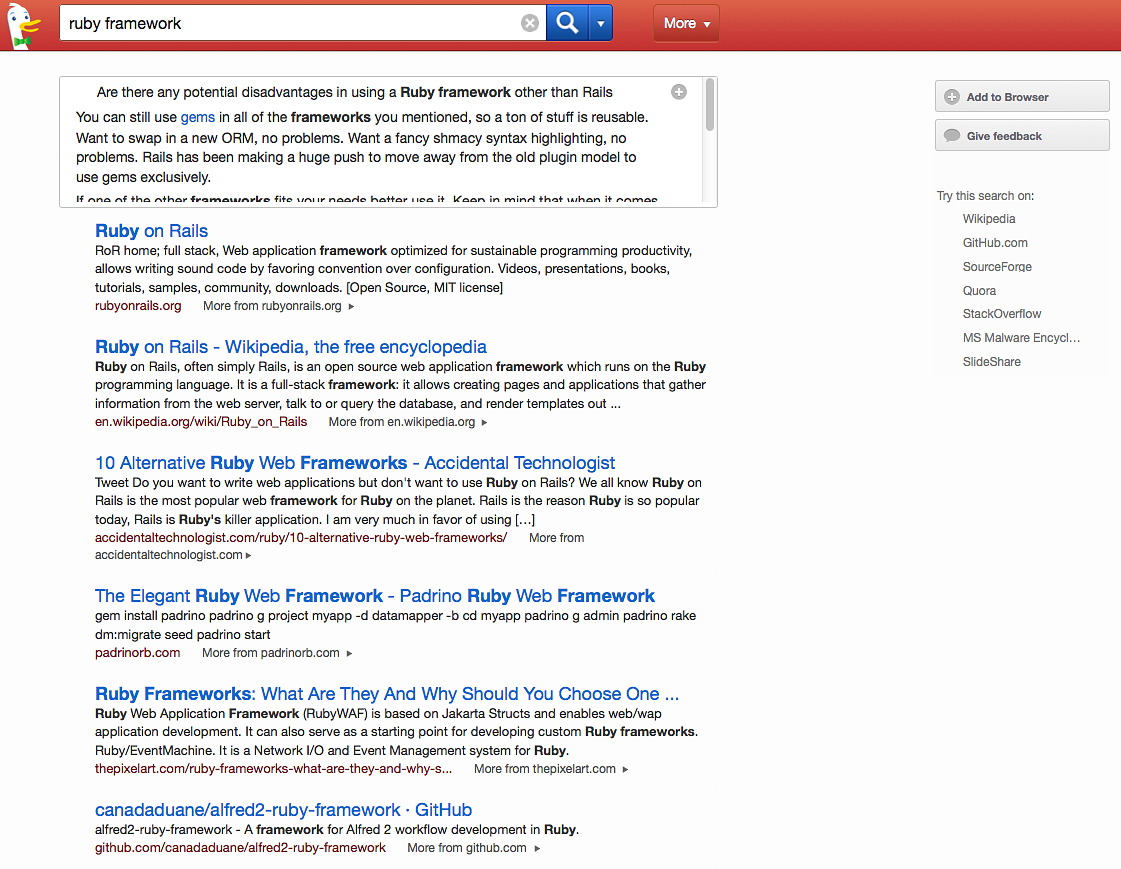
You need to change this in the settings, but seeing a search engine give you this choice is refreshing. For a while, it seemed that Google was hell-bent on pushing as many ads down your throat as possible on a single page.
DuckDuckGo does offer a few extras to help with other tasks besides searching. Aside from the typical math calculations you can enter, you can also do the following:
- Expand shortened URLs with the expand command followed by the URL you wish to expand, e.g.
expand [bit.ly/a](http://bit.ly/a), which will show you the expanded URL on a search results page. - Search other sites for things, e.g.
on railswill search the Hacker News website for stories and comments containing ‘rails’. - Generate a password for an account. For example,
password 15 strongwill generate a strong password of 15 characters.
DuckDuckGo also provides operators that you can use in your searches. It simply means that you can search through other sites right from DuckDuckGo. I use it often for searches on Amazon using !a and Wikipedia using !w. Couple these with searching DuckDuckGo from Alfred, and I have a fast and easy way of searching DuckDuckGo and other sites.
Since I started using DuckDuckGo, I’ve been impressed with its results and capabilities as a search engine. Every day, I learn new shortcuts and ways of searching. That means less mouse clicks for me and less time spent tracking down the search box on other websites. It’s flexible and fast and well worth checking out if you’re looking for an alternative to not just Google but also Yahoo and Bing.
Update: Some links in this post pointed to pages that no longer exist and have been removed.
The Latest Addition to my Feed Reader ...
… a blog on note-taking.
Update: Some links in this post pointed to pages that no longer exist and have been removed.
Feeding our Reading Habits - The Book
Alex Kessinger has compiled all his blog posts on the future of feed readers into one handy little book. The full document is here but there’s also downloads in the form of a PDF and a Kindle book.
It’s great that Alex has done this as feed readers really are an underappreciated tool. I’m actually glad to see that Google’s Reader platform being turned off. It’s opened the market for more feed readers that each have their own thing to offer.
Update: Some links in this post pointed to pages that no longer exist and have been removed.
Feedbin: A Review

With Google Reader going soon, people have been looking for a replacement RSS Reader. Fortunately for me I decided look for an alternative a few weeks ago when I wanted to go Google free. I looked at a number of different options for an alternative RSS reader at the time, but Feedbin really stood out for me.
It’s a paid product. Not free. That’s important for me because I want to use the product in the long term. Supporting this product by paying money to use it is just common sense. Free products can come and go but investing your money in a product provides some sense of insurance that it will be around longer. This is by no means a guarantee that Feedbin will be around forever. An annual Feedbin subscription is just $20 per year.
As an RSS reader, Feedbin does everything you expect a reader to do. You can subscribe to feeds using the textbox at the top of the screen. Underneath this are three panes. The far left is your list of feeds or folders of feeds if you like to be organised.

The next pane is the items in that RSS feed or folder. You can navigate these easily with the mouse or with keyboard shortcuts.

Finally the far right pane is the current item you are viewing or the reading pane.

Keyboard shortcuts can be used to move about between feeds, folders and items. From what I remember most of the shortcuts are similar to Google Reader so those migrating from Google Reader should be able to pick up the new shortcuts quite fast. As an ex-Reader user, I find it easy to navigate about Feedbin.
Feedbin also has support for sharing to an extensive range of services. You can share items to many services like Instapaper, Pocket and Evernote. This is done through the use of URLs that many services provide. Feedbin provides tokens that can be used within these URLs so that you can include the entry title, url and feed name within the URL to the service you wish to share to. I love this feature as it simple to customize what you’re sharing. Some people may not like that it’s not truly integrated with other services and instead relies on just URLs to share to other services, but given the number of services Feedbin can share to, I can wait for better integration.
Finally there’s iOS support. The Reeder app is the best way to view your Feedbin feeds on your iPhone. Unfortunately at the moment there is no Reeder support for Feedbin on the iPad or OSX, however Reeder development will resume at the start of July and hopefully we’ll see more Reeder support coming.
It’s an interesting time for RSS readers. Many people are turning to Feedly as a replacement for Google Reader, but I just didn’t like the Feedly interface or the it’s iOS applications. In the time that I have used Feedbin I’ve had no reason to complain about the service. Aside from the unread counts being a little out on some feeds Feedbin really is a great little RSS reader. I’m looking forward to seeing what the future holds for Feedbin.
Update: Shortly after this review was written, Feedbin was moved to much faster servers. Performance of Feedbin on the previous hardware wasn’t much of an issue for me but I did read about others complaining of speed and response time. On the new setup though Feedbin is definitely faster than it was previously.
This afternoon I said goodbye to my Twitter handle, @matthewlang and deactivated my account there. It’s been a move I’ve been thinking a lot about over the last few weeks. Since the start of the year my Twitter use has really declined. I just don’t have the time for Twitter, and I was increasingly finding it to be more of a distraction than anything else.
In the last few weeks I’ve deleted my Google account and now another aspect of my on-line presence is gone. And it’s no bad thing either. Having lots of networks and profiles attached to your name isn’t a good thing in my book. Stretching yourself across multiple networks and services takes a lot of your time. That’s time I just don’t have.
There are of course accounts on networks and services I do have like LinkedIn and Github, but these are important to me and they don’t require a lot of time.
I also have a personal website and blog that I post to on a daily basis. I find that writing for my blog gives me more to say on a topic than Twitter ever could. Given the choice between spending time on Twitter or writing for my blog, I’d much rather spend the time writing for my blog.
Time to leave Twitter?
It’s a well known fact that if you’re a reader of my blog, you’ll know that I love the App.net service. A subscription based network for those that want something more than just ads in their timeline. Since taking up residence on App.net, I’ve found that I am no longer as active on Twitter.
These days I check it about once a week. Only out of habit really. Previously I was following just 50 accounts on Twitter and today I cut that number in half. I’m now following just 25 accounts. The plan over the next few weeks is simply get this following count down to zero and then delete my account.
I just don’t get as much value from Twitter these days. I don’t find client work on Twitter, I don’t use it for marketing myself as a freelancer (that’s what my website is for) and it’s been a long time since I marked anything as a favourite there. Really it’s just another placeholder for me on the web, but is it really that important to have a Twitter presence now? Once I delete my account it will be gone forever. I might be lucky enough to get my username back if I sign up again but the chances of that happening are remote.
Anyone else out there considering giving Twitter the chop?
Update: Some links in this post pointed to pages that no longer exist and have been removed.
Goodbye Feedly, Hello Feedbin
Feedly has been my choice of RSS reader for about 2 years now. Initially I was won over by a service that provided a better user experience but still allowed me to continue to use Google Reader as my main RSS reader.
Feedly was a great application but lately I’ve become a little bit weary of it. One particular problem I have is the number of times I need to log back in. I’ve got Feedly running on my Macbook, iPad and iPhone. About once a week I would need to log back in on either the iPad or the iPhone. Logging in each week can be a bit of a pain. Especially as it’s linked to my Google account.
It was time to look for something else.
After some searching I found the RSS reading service Feedbin. It’s a subscription service with a web client that also works with the Reeder app for the iPhone.
At just $2 per month or $20 for the year, it’s relatively cheap, but as a paid service it at least has more of a fighting chance of being around in the long term.
I’ve taken the $20 for the year offer as I want to try Feedbin for the long term. With the use of Reeder I have a supporting app for my iPhone that can let me use my Feedbin account. It will be interesting to see how Feedbin pans out as my main RSS reader over the next year.
Here is today
RSS is not dead
While trawling through my RSS feeds looking for blogs to unsubscribe from, I came across Andrew Chen’s blog post about his decision to completely remove the RSS feed from his site.
As of today, I’ve removed the links the RSS feeds on this blog, and ultimately will phase them out completely in favor of email.
— RSS I quit you.. by Andrew Chen
Not a wise decision in my eyes and here’s why.
Your inbox isn’t an RSS reader
Using email to subscribe to web sites only works for a handful of blogs. You could comfortably subscribe to about five blogs and you would be able to manange reading a few emails a week from these blogs if they were not to frequent. Doing this for anything in the double digits number of blogs is a bad idea.
I don’t want to flood my inbox with tons of emails from different blogs. Thats why I use RSS. That’s why I use a RSS reader. I subscribe to the sites that I want to follow and then I can batch my reading of those sites to a time that suits me.
It’s convenient and it works.
RSS isn’t dead
Many people are starting to wonder if Google Feedburner will be next for the chop from Google but even if it was to be shut down, that’s no indication to say that RSS is dying or dead. All it says is that Google isn’t interested in dealing with a an RSS product.
RSS is alive and well everywhere. You can still find RSS feeds for millions of blogs and websites and Feedly are doing a great job of bringing over hundreds of people from Google Reader to their feed reading service. In the last few years there have a number of great RSS feed readers released on tablets and smartphones so that you read on the go.
Completely removing the RSS feed from your blog is a bad idea. After reading Andrew’s post I found another website that I can unsubscribe from.
Sorry Andrew.
Matt Gemmell on App.Net and Conversation
Matt Gemmell has an excellent post on the community that has built up around App.Net and why he’d like you to consider joining.
The practical effect, which I notice daily, seems to be that people are more willing to participate in conversations, and also more careful about how they express themselves. Such a broad generalisation has no hope of being true for everyone, but it’s been my consistent perception during the months I’ve been using the service.
— App.Net for conversations by Matt Gemmell
Update: Some links in this post pointed to pages that no longer exist and have been removed.
So Google Reader is finally being killed off. The RSS reader that spurred many clones and provided a way for you to follow any number of your favourite blogs easily is to close down this summer.
With very few updates to the service in the last couple of years it is hardly surprising. It might be a bad day for Google Reader fans but there’s an opportunity here for someone to earn themselves a nice fortune.
The space left my Google Reader now means that there’s a place for a well designed cross platform RSS Reader.
And I’m willing to pay for it.
Over the next few days I’m going to be looking for an alternative to Google Reader. It’s sad to see the service go but nothing is forever. The one good thing from this is that Google Reader already provides a way for you to export your feeds. Shouldn’t be too difficult to get up and running on something else soon.
Tips on getting through your RSS feeds faster
Let me get this clear to start with. I only use my RSS reader to scan feeds from blogs that I am subscribed to. This post is just tips for getting through your RSS feeds without taking the time to read anything.
Group your feeds
Grouping your feeds is a great way to batch feeds for scanning. I group my feeds into a number of groups based on the general topics of each feed. I have groups for web development, tech businesses, bikes, picture blogs and online products and services I use.
Grouping feeds in this way means that when you scan the feeds, you’re scanning a particular topic rather than scanning a list of feeds of completely different topics.
Scan the headlines
Don’t read everything. Unless you’re following between 10 and 20 blogs, you’ll never be able to read everything in a short period of time. Instead scan the headlines of your feeds for interesting posts.
I used to read everything in my feeds in case I missed something, but reading everything takes a long time. Yes, scanning the headlines of your feeds might means you miss an interesting post, but you’ll get through your feeds a lot faster.
Use a read it later service like Instapaper
RSS readers are great for categorising and scanning your feeds, but I like to use a separate service for reading. Many RSS readers let you favourite individual articles and send them to another service like
Instapaper so that you can read them at a later date.
Read it later services also let you collect articles for reading at a later date when it suits you. I tend to get through my feeds first thing in the morning. I favourite posts I want to read later. When I favourite my posts, they are sent to my Instapaper account so that I can read them later on. Many RSS readers have this feature built in and read it later services like Instapaper also have settings that let you import favourite posts from your RSS reader.
Keep a list of blogs to scan daily
I have a group of feeds that I want to scan on a daily basis. I scan this group every day first thing. It’s a collection of blogs of varying topics, but they’re blogs that I find highly valuable and therefore they’re the blogs I scan every day.
Trim dead or rarely posted feeds
I don’t subscribe to a feed that posts once a month or less frequently. I like content on at least a weekly basis from a feed. Every 2 or 3 months I check the feeds I am subscribed to determine if they’re still delivering a steady stream of content.
Google Reader is great for this as it tracks the stats of each the feeds you have subscribed to. Staying on top of your feeds this way means that you can delete stale feeds and therefore have less headlines to scan.
RSS feeds and readers have fallen out of fashion with many on the Internet, but as long as people are still blogging, there will always be a place for RSS readers to consume these blogs.
Update: Some links in this post pointed to pages that no longer exist and have been removed.
Why I love being a Netter
Netter and netizen are just a couple of the words I’ve heard used to describe the people on
App.net. The social network (dare I use the term) burst onto the scene in 2012 with promise of being a self sustaining ad-free social network that will be paid for by it’s users by an annual subscription fee. I joined in August 2012 and now six months on, I’m still thoroughly enjoying the experience on App.net.
I still have my Twitter account and I now use it purely as a marketing tool for freelancing. I was on Twitter during the week, doing a quick poll from other developers. Within a few minutes of posting my tweet, the first in about a week, I got two follower requests from spam accounts and I also got a couple of replies to my question from spam accounts.That’s what really gets me about Twitter. It’s the spam. With a majority of the tweets I make, I end up with a couple of new follower requests from vague accounts that I would rather didn’t follow me. On App.net though things are a little difference. The subscription fee is the perfect entry barrier to weed out spam accounts. I’ve never have to block a vague account on App.net.Then there’s the people. Okay, I’m missing a few people on App.net that are on Twitter, but then there’s people on App.net who aren’t on Twitter. It’s a whole different crowd. On Twitter I mainly follow other developers who work with the Ruby programming language but on App.net I’m following a wider range of people. A wider range means different content to read on a daily basis.
Finally there’s the features that App.net are rolling out. In the past few months, private messaging and file storage have been two big announcements in App.net. Now these might be conceived as typical features for a social network, but where App.net is different is that these features were built to be transparent and easily managed by App.net’s users. Take the file storage within App.net. With just a click, I can export all the files I have stored in App.net so that I can take them elsewhere. Yes other social networks might offer this, but App.net built this in from the start. Features are built with the user in mind, not with advertising in mind.I’m glad to be part of a social network that puts its users first. It definitely beats being another cog in an advertising platform.
Update: Some links in this post pointed to pages that no longer exist and have been removed.
Todays physics lesson ...
… brought to you by xkcd.
Do you follow the church of ...
… the Internet?
And over at xkcd today ...
How appropriate for today’s massive tech companies.

Click and Drag
Today’s XKCD is amazing.
Enjoy.
Because everything you use and do on the web doesn’t need to be freaking instantaneous. The slow web is definitely the way forward.
Update: Some links in this post pointed to pages that no longer exist and have been removed.
The world is buggered. We need to go elsewhere, but can we all go? Excellent physics questions and answers over at xkcd.
Fun physics at xkcd
Answering the questions in physics that you didn’t ask at school. This time it’s a mole of moles.